
Select Page

Okta Certification Training – The only IAM Course you need

Okta Certification Training – The only IAM Course you need

⏰24 hours | ▶️ 24 Videos | 📣 49 Participants | 🔥11 Reviews

Choose a Plan that Works for You

Course Description

Okta Training, You certainly go through the advanced platform, which is a cloud-based identity security tool that connects all your applications, logins, and devices.

This course welcomes you with new categories too. Like it is a platform that runs upon identity-as-a-service, which is a subset of cloud computing.

Okta was the apparent option for us to handle the various cloud apps we use to run our company.

As you will attend Online Classes for this Training, you will learn a lot more things about Okta functionalities.

Okta offers cloud software that enables companies to automate and protect user authentication in applications and for developers to integrate identity controls into apps, websites, web services, and computers.

Okta Certified Professionals are well-versed in the principles of safe identity management and mobility. In addition, they have firsthand experience performing day-to-day organizational activities to assist Okta users.
Course Content

1.Introduction to SSO

  • Identity and Access Management with Okta: An Introduction
  • Introduction to Workforce Identity
  • Manage Users and Groups in okta

2.Universal Directory, User and Group Management

  • Integrate Okta with Active Directory-Mastered Users
  • OKTA Universal Directory Concept                                                                     
  • Profile Editor Concept
  • Manage Application Single Sign-On (SSO)

3.Application Integration

  • SAML Application Configuration with OKTA
  • SWA Application Configuration with OKTA
  • Bookmark Application Configuration with OKTA
  • Open ID Connect Configuration with Okta
  • Oauth Configuration with Okta
  • Automate Lifecycle Management

4.Rules and Policy in okta

  • Implement Multifactor Authentication (MFA)
  • Implement Sign on Policy
  • Implement Application Sign on Policy
  • Group Rules
  • Authorization Server Rules

5.OKTA

  • Intro to OKTA

    • Compare OKTA with Active directory Federation Server
    • OKTA Architecture
    • OKTA Universal Directory Concepts
    • Groups and Group rules
    • Self-service registration
    • Profile Editor Concepts
    • Types of Administrators and their permissions
    • Implement and configure MFA
    • Configure adaptive MFA
    • Configure Networks
    • SAML Application Configuration with OKTA
    • SWA Application Configuration with OKTA
    • Bookmark Application Configuration with OKTA
    • OIDC Application Configuration with OKTA
    • Manage SSO and Provisioning
    • Reports and System log
    • Basic troubleshooting steps for OKTA in SAML perspective

6.API Access Management

  • API access Management
  • Use of API token
  • Configure Trusted Origin
  • Configure Authorization Server
  • Different Kind of Admin Role in okta                                                                       
  • Rest API
  • Use of API call in Postman
  • Learn about different kind of token Access token, ID token, Refresh Token
  • Learn about postman tool
  • Bulk user creation, Deletion by API call
  • Assigned Bulk User to a group by API call
  • Configure Universal Directory and User Profiles

7.Okta End User Support

  • Navigating the Okta Help Center
  • Modifying your OKTA instance look and feel
  • Walk Through of OKTA console and explain each topic in detail
  • Monitoring OKTA Trust Portal
  • Contacting OKTA Support in case of support
  • Best Configuration practices for an OKTA Instance

8.Troubleshooting

  • Different Kind of end User login issue
  • SAML based Application Troubleshooting
  • OIDC based Application Troubleshooting
  • Policy and MFA issues
  • Discuss Different Type of API call

9.Lab

  • How to Make Account in Okta
  • Create Users and groups in Okta
  • Create Group Rule
  • How to Make a server and deploy AD role into the server
  • AD integration with Okta
  • Service Now (Saml Based Application) Integration
  • Open ID Integration with OIDC debugger
  • Facebook Integration with okta (SWA bases Application)
  • Implementation of Password Policy
  • Creation of Network Zone
  • How to Generate reports in Okta
  • Configure MFA into different Application
  • Postman setup
  • Postman Setup with Okta
  • How to Use API Calls
  • Cover Each Tab of Okta

10.Requirements

  • Basic understanding of Identity and Access Management
  • Basic familiarity with Active Directory
  • Basic networking knowledge
  • Access to an Okta org (free trial is fine)
  • Access of Azure (Free trail is Fine)
  • Postman Tool
  • Laptop with Window 10/8

11.Students will learn how to

  • Integrate Okta into an existing organization
  • Identify the features and functions of Okta
  • Create and configure user accounts within Okta
  • Integrate Okta with AD
  • Create and manage groups
  • Configure applications for secure access
  • Configure password policies and multi-factor authentication
  • Many More (Full Okta Content mentioned above)
FAQ’s

(more…)

Okta Online Training – The only IAM Course you need

Okta Online Training – The only IAM Course you need

⏰24 hours | ▶️ 24 Videos | 📣 49 Participants | 🔥11 Reviews

Choose a Plan that Works for You

Course Description

Okta Training, You certainly go through the advanced platform, which is a cloud-based identity security tool that connects all your applications, logins, and devices.

This course welcomes you with new categories too. Like it is a platform that runs upon identity-as-a-service, which is a subset of cloud computing.

Okta was the apparent option for us to handle the various cloud apps we use to run our company.

As you will attend Online Classes for this Training, you will learn a lot more things about Okta functionalities.

Okta offers cloud software that enables companies to automate and protect user authentication in applications and for developers to integrate identity controls into apps, websites, web services, and computers.

Okta Certified Professionals are well-versed in the principles of safe identity management and mobility. In addition, they have firsthand experience performing day-to-day organizational activities to assist Okta users.

Course Content

1.Introduction to SSO

  • Identity and Access Management with Okta: An Introduction
  • Introduction to Workforce Identity
  • Manage Users and Groups in okta

2.Universal Directory, User and Group Management

  • Integrate Okta with Active Directory-Mastered Users
  • OKTA Universal Directory Concept                                                                     
  • Profile Editor Concept
  • Manage Application Single Sign-On (SSO)

3.Application Integration

  • SAML Application Configuration with OKTA
  • SWA Application Configuration with OKTA
  • Bookmark Application Configuration with OKTA
  • Open ID Connect Configuration with Okta
  • Oauth Configuration with Okta
  • Automate Lifecycle Management

4.Rules and Policy in okta

  • Implement Multifactor Authentication (MFA)
  • Implement Sign on Policy
  • Implement Application Sign on Policy
  • Group Rules
  • Authorization Server Rules

5.OKTA

  • Intro to OKTA

    • Compare OKTA with Active directory Federation Server
    • OKTA Architecture
    • OKTA Universal Directory Concepts
    • Groups and Group rules
    • Self-service registration
    • Profile Editor Concepts
    • Types of Administrators and their permissions
    • Implement and configure MFA
    • Configure adaptive MFA
    • Configure Networks
    • SAML Application Configuration with OKTA
    • SWA Application Configuration with OKTA
    • Bookmark Application Configuration with OKTA
    • OIDC Application Configuration with OKTA
    • Manage SSO and Provisioning
    • Reports and System log
    • Basic troubleshooting steps for OKTA in SAML perspective

6.API Access Management

  • API access Management
  • Use of API token
  • Configure Trusted Origin
  • Configure Authorization Server
  • Different Kind of Admin Role in okta                                                                       
  • Rest API
  • Use of API call in Postman
  • Learn about different kind of token Access token, ID token, Refresh Token
  • Learn about postman tool
  • Bulk user creation, Deletion by API call
  • Assigned Bulk User to a group by API call
  • Configure Universal Directory and User Profiles

7.Okta End User Support

  • Navigating the Okta Help Center
  • Modifying your OKTA instance look and feel
  • Walk Through of OKTA console and explain each topic in detail
  • Monitoring OKTA Trust Portal
  • Contacting OKTA Support in case of support
  • Best Configuration practices for an OKTA Instance

8.Troubleshooting

  • Different Kind of end User login issue
  • SAML based Application Troubleshooting
  • OIDC based Application Troubleshooting
  • Policy and MFA issues
  • Discuss Different Type of API call

9.Lab

  • How to Make Account in Okta
  • Create Users and groups in Okta
  • Create Group Rule
  • How to Make a server and deploy AD role into the server
  • AD integration with Okta
  • Service Now (Saml Based Application) Integration
  • Open ID Integration with OIDC debugger
  • Facebook Integration with okta (SWA bases Application)
  • Implementation of Password Policy
  • Creation of Network Zone
  • How to Generate reports in Okta
  • Configure MFA into different Application
  • Postman setup
  • Postman Setup with Okta
  • How to Use API Calls
  • Cover Each Tab of Okta

10.Requirements

  • Basic understanding of Identity and Access Management
  • Basic familiarity with Active Directory
  • Basic networking knowledge
  • Access to an Okta org (free trial is fine)
  • Access of Azure (Free trail is Fine)
  • Postman Tool
  • Laptop with Window 10/8

11.Students will learn how to

  • Integrate Okta into an existing organization
  • Identify the features and functions of Okta
  • Create and configure user accounts within Okta
  • Integrate Okta with AD
  • Create and manage groups
  • Configure applications for secure access
  • Configure password policies and multi-factor authentication
  • Many More (Full Okta Content mentioned above)

FAQ’s

(more…)

Okta Admin Training – The only IAM Course you need

Okta Admin Training – The only IAM Course you need

⏰24 hours | ▶️ 24 Videos | 📣 49 Participants | 🔥11 Reviews

Choose a Plan that Works for You

Course Description

Okta Training, You certainly go through the advanced platform, which is a cloud-based identity security tool that connects all your applications, logins, and devices.

This course welcomes you with new categories too. Like it is a platform that runs upon identity-as-a-service, which is a subset of cloud computing.

Okta was the apparent option for us to handle the various cloud apps we use to run our company.

As you will attend Online Classes for this Training, you will learn a lot more things about Okta functionalities.

Okta offers cloud software that enables companies to automate and protect user authentication in applications and for developers to integrate identity controls into apps, websites, web services, and computers.

Okta Certified Professionals are well-versed in the principles of safe identity management and mobility. In addition, they have firsthand experience performing day-to-day organizational activities to assist Okta users.

Course Content

1.Introduction to SSO

  • Identity and Access Management with Okta: An Introduction
  • Introduction to Workforce Identity
  • Manage Users and Groups in okta

2.Universal Directory, User and Group Management

  • Integrate Okta with Active Directory-Mastered Users
  • OKTA Universal Directory Concept                                                                     
  • Profile Editor Concept
  • Manage Application Single Sign-On (SSO)

3.Application Integration

  • SAML Application Configuration with OKTA
  • SWA Application Configuration with OKTA
  • Bookmark Application Configuration with OKTA
  • Open ID Connect Configuration with Okta
  • Oauth Configuration with Okta
  • Automate Lifecycle Management

4.Rules and Policy in okta

  • Implement Multifactor Authentication (MFA)
  • Implement Sign on Policy
  • Implement Application Sign on Policy
  • Group Rules
  • Authorization Server Rules

5.OKTA

  • Intro to OKTA

    • Compare OKTA with Active directory Federation Server
    • OKTA Architecture
    • OKTA Universal Directory Concepts
    • Groups and Group rules
    • Self-service registration
    • Profile Editor Concepts
    • Types of Administrators and their permissions
    • Implement and configure MFA
    • Configure adaptive MFA
    • Configure Networks
    • SAML Application Configuration with OKTA
    • SWA Application Configuration with OKTA
    • Bookmark Application Configuration with OKTA
    • OIDC Application Configuration with OKTA
    • Manage SSO and Provisioning
    • Reports and System log
    • Basic troubleshooting steps for OKTA in SAML perspective

6.API Access Management

  • API access Management
  • Use of API token
  • Configure Trusted Origin
  • Configure Authorization Server
  • Different Kind of Admin Role in okta                                                                       
  • Rest API
  • Use of API call in Postman
  • Learn about different kind of token Access token, ID token, Refresh Token
  • Learn about postman tool
  • Bulk user creation, Deletion by API call
  • Assigned Bulk User to a group by API call
  • Configure Universal Directory and User Profiles

7.Okta End User Support

  • Navigating the Okta Help Center
  • Modifying your OKTA instance look and feel
  • Walk Through of OKTA console and explain each topic in detail
  • Monitoring OKTA Trust Portal
  • Contacting OKTA Support in case of support
  • Best Configuration practices for an OKTA Instance

8.Troubleshooting

  • Different Kind of end User login issue
  • SAML based Application Troubleshooting
  • OIDC based Application Troubleshooting
  • Policy and MFA issues
  • Discuss Different Type of API call

9.Lab

  • How to Make Account in Okta
  • Create Users and groups in Okta
  • Create Group Rule
  • How to Make a server and deploy AD role into the server
  • AD integration with Okta
  • Service Now (Saml Based Application) Integration
  • Open ID Integration with OIDC debugger
  • Facebook Integration with okta (SWA bases Application)
  • Implementation of Password Policy
  • Creation of Network Zone
  • How to Generate reports in Okta
  • Configure MFA into different Application
  • Postman setup
  • Postman Setup with Okta
  • How to Use API Calls
  • Cover Each Tab of Okta

10.Requirements

  • Basic understanding of Identity and Access Management
  • Basic familiarity with Active Directory
  • Basic networking knowledge
  • Access to an Okta org (free trial is fine)
  • Access of Azure (Free trail is Fine)
  • Postman Tool
  • Laptop with Window 10/8

11.Students will learn how to

  • Integrate Okta into an existing organization
  • Identify the features and functions of Okta
  • Create and configure user accounts within Okta
  • Integrate Okta with AD
  • Create and manage groups
  • Configure applications for secure access
  • Configure password policies and multi-factor authentication
  • Many More (Full Okta Content mentioned above)

FAQ’s

(more…)

Salesforce Developer Training – The only Course you need

Salesforce Developer Training – The only Course you need

⏰26 hours | ▶️ 23 Videos | 📣 7406 Participants | 🎓 2458 Reviews | 4.7 ⭐⭐⭐⭐⭐

Choose a Plan that Works for You

Upcoming Batches PST

 Weekday 

Jan 07(1 HR A DAY)
06:30 PM PST
Enroll Now  →

 Weekday 

Jan 28(1 HR A DAY)
07:30 AM PST
Enroll Now  →


 Weekend

Jan 24(1 HR A DAY)
08:30 PM PST
Enroll Now  →

Upcoming Batches IST

 Weekday 

Jan 08(1 HR A DAY)
07:00 AM IST
Enroll Now  →

 Weekday 

Jan 28(1 HR A DAY)
08:00 PM IST
Enroll Now  →

 Weekend 

Jan 25(1 HR A DAY)
09:00 AM IST
Enroll Now  →

Course Description

So you want to learn Salesforce Dev? Great job!

Do you know Salesforce Dev is the most trending course?

There are massive opportunities in Salesforce Dev as it leads the market.

Our Salesforce Dev Training course is a job oriented course ie at the end of the course you can
easily clear interviews or on board into an ongoing Salesforce Dev project.

Also the salaries in Salesforce Dev is very impressive (Indeed.com report)

1.Introduction to Force.com – Apex:

  • What is MVC Pattern in Salesforce.com
  • What is an Apex and how it works? – with sharing and without sharing
  • Introduction to Oops and its features
    • Class
    • Object
    • Encapsulation
    • Polymorphism
    • Inheritance
    • Abstraction

2.Apex Contd.:

  • Different data types, looping controls, expressions etc.
  • Writing sample apex class by using the above requirements.
  • Introduction to Apex data types
  • Introduction to Collection using LIST/SET and MAP
  • Iteration of LIST/SET and MAP using loop and Iterator
  • Exception Handling in Apex

3.Introduction to SOQL:

  • How to Write SOQL in Salesforce
  • How to Use SOQL in Apex – how to Iterate SOQL
  • How to travel from Child to Parent in SOQL
  • How to travel from Parent to Child in SOQL
  • How to execute query in developer console

4.Introduction to SOSL:

  • How to Write SOSL in Salesforce
  • How to Use SOSL in Apex – how to Iterate SOSL

5.Introduction to Visual Force:

  • What is Visualforce Page?
  • Create a Sample Visualforce Page i.e. putting Java script etc…
  • Displaying Field Values,Related Lists on a Page
  • What is Controller?Different types of Controllers?- Standard Controller and Custom Controllers and extension controller
  • How to Travel from Parent to Child in Visual Force – using Child Relationship Name
  • How to invoke the apex?
  • How to Iterate in Visualforce using Data Table/Data list/ Page Block Table
  • How to Launch Visual Force page as a Tab
  • Performing DML operations from Visualforce pages

6.Introduction to Trigger and its Best Practices:

  • Objectives of writing a trigger in Salesforce with Live Use Case
  • Trigger Events
  • Trigger Context Variables
  • Calling handler classes from triggers
  • Using List and Set in Triggers, making them bulkfy
  • Best Practices of Triggers

7.Introduction to Test Classes in Salesforce:

  • Understanding Testing in Apex
  • Why unit test coverage and its best practices
  • Write Test Class For Apex Class & Trigger
  • How to create Test Data
  • How to access private data members of a class in test classes
  • Best practices of writing Test classes

8.Introduction to Batch Classes in Salesforce:

  • Understanding Batch in Apex
  • Why batch classes required and its best practices
  • Write Batch classes – Live implementation

9.Introduction to Schedulable in Salesforce:

  • Understanding Schedulable in Apex
  • Why Schedulable classes required and its best practices
  • Write Schedulable classes – Live implementation

10.Introduction to Web services/Integration:

  • Why Web Services required in salesforce
  • Creating RESTFUL Web Services – using Live example – Consuming and Exposing
  • Best Practices of Writing web services

11.Deployment Model using Change Set:

 How to Deploy from One Sandbox to Another Sandbox
 How to Deploy from Sandbox to Production using Change Set

12.Live Scenario, Doubts Session and How to work on Real Env.:

  • Live Scenario, Doubts Session and How to work on Real Env.

Misc.:

  • How to define Constants
  • Custom Settings
  • Custom Label
  • Remote site setting
  • Connected Apps
  • Apex Sharing

FAQ’s

(more…)

Workday Advanced Reporting Training – The only Course you need

Workday Advanced Reporting Training – The only Course you need

⏰15 hours | ▶️ 24 Videos | 📣 9715 Participants | 🎓 4268 Reviews | 4.7 ⭐⭐⭐⭐⭐

Choose a Plan that Works for You

Upcoming Batches PST

 Weekday 

Feb 09(1 HR A DAY)
07:30 PM PST
Enroll Now  →

 Weekday

Feb 25(1 HR A DAY)
08:30 AM PST
Enroll Now  →

 Weekend 

Feb 21(1 HR A DAY)
08:00 AM PST
Enroll Now  →

Upcoming Batches IST

 Weekday 

Feb ​​10(1 HR A DAY)
08:00 AM IST
Enroll Now  →

 Weekday 

Feb 25(1 HR A DAY)
09:00 PM IST
Enroll Now  →

 Weekend 

Feb 22(1 HR A DAY)
08:30 PM IST
Enroll Now  →

Course Description

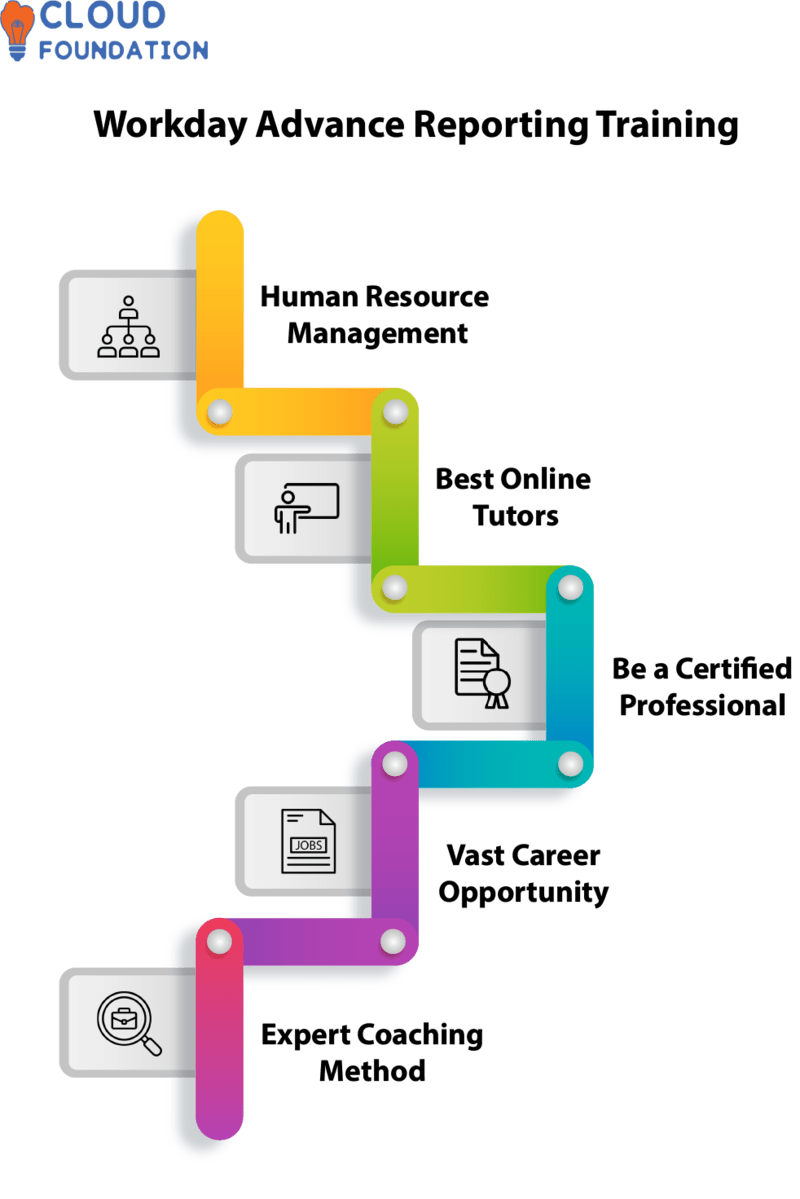
Workday Advanced reporting Training plays a capable role in aleadership configuration of the Human resource management success.

Now learn the upgraded technology skills in the Workday advanced reporting and in reporting field to demonstrate it variously through our best online classroom tutors in CloudFoundation.

TheCourse aligns your workforce with your organization’s goals and initiatives.

This core system software process leads both business and financial systems to operate in one place and get progress efficiently.

It plays a prominent role in the functionality of business needs and many various object complexes.

Grab a significant leading and vast opening opportunity for your job career now with this.

Be a certified professional in workday Advanced reporting Training by our experienced Coaching method where you can crack your Certification at any time and anywhere.

Course Content

1.Composite Reports

  • Create Composite Reports
  • Enable Business Objects for Filtering and Grouping
  • ​​Setting Up Composite Report’s Columns, Rows, and Cells
  • ​​Additional Options for Composite Reports
  • ​​Setting Up Output Options for Composite Reports
  • ​​Create Outline Structures for Composite Reports
  • ​​Formatting Styles
  • ​​Prompt Sets for Composite Reports
  • ​​Composite Report Columns
  • ​​Composite Report Rows
  • ​​Composite Report Cells
  • ​​Create a Report on the Gender Breakdown of Active Workers

2.Trending Reports Overview

  • Creating Trending Reports
  • ​​Setting Up Trending Reports
  • ​​Trended Workers Data
  • ​​Tenants for Trended Worker Reporting
  • ​​ Trended Workers Data Source Overview
  • ​​Find Custom Reports Based on the Trended Workers Data Source
  • ​​Trended Workers Data Source
  • ​​Reporting on the Trended Workers Data Source

3.Transposed Reports Overview

  • Create Transposed Reports
  • ​​Rows for Transposed Reports

4.Search Reports Overview

  • Overview of Search Report
  • Create Search Reports

5.nBox Reports view

  • Create nBox Reports
  • Matrix Options for nBox Reports

6.Worklets and Dashboards

  • Custom Dashboards
  • ​​Create Custom Dashboards
  • ​​Configure Dashboard Content
  • ​​Enable Reports for Related Worklets
  • ​​Save Custom Prompt Values for
  • ​​Custom Worklets
  • ​​Worklet Performance

7.Custom Metrics and Scorecards Overview

  • Create Custom Metrics and Scorecards
  • ​​Analytic Scorecard Profiles and Metric Sets
  • ​​Create Custom Metrics
  • ​​Custom Reports for Scorecards
  • ​​Process and Review Metrics
  • ​​Workday Scorecards Overview
  • ​​Custom Scorecard Report Definition
  • ​​Scorecard Results
  • ​​Metric Calculations for Dependent

FAQ’s

(more…)

Guidewire Billing Center Training – The only Course you need

Guidewire Billing Center Training – The only Course you need

⏰24 hours | ▶️ 24 Videos | 📣 8120 Participants | 🎓 5723 Reviews | 4.9 ⭐⭐⭐⭐⭐

Choose a Plan that Works for You

Upcoming Batches EST

 Weekday 

Feb 10(1 HR A DAY)
07:00 PM PST
Enroll Now  →

 Weekday 

Feb 27(1 HR A DAY)
07:00 AM PST
Enroll Now  →

 Weekend

Feb 23(1 HR A DAY)
06:30 PM PST
Enroll Now  →

Upcoming Batches IST

 Weekday 

Feb 11(1 HR A DAY)
07:30 AM IST
Enroll Now  →

 Weekday 

Feb 27(1 HR A DAY)
07:30 PM IST
Enroll Now  →

 Weekday 

Feb 22(1 HR A DAY)
07:00 AM PST
Enroll Now  →

Course Description

Guidewire Billing Center Training is a complete CMS(Content Management Solution) for developing websites, Mobile Applications and Forms. It is used to handle your marketing assets. Through Guidewire Billing Center Training, you can increase your brand demand and Customer Loyalty. By 2025, Guidewire Billing Center Training will become one of the top content management systems.

After analyzing its progress in the market, we have designed this course based on the latest trends.

Major companies using Guidewire Billing Center Training are Dell, Barclays, Deloitte, Informatica, Mastercard, Microsoft, UBS, Thermo Fisher Scientific, DuPont, Palo Alto Networks.

The average salary of Guidewire Billing Center Training per annum is $168,200 – Neuvoo

Guidewire Billing Center Training training will help you develop the skills and knowledge necessary for building custom applications using templates and components.

It covers all the fundamentals of including architecture, JCR, OSGi framework, etc., through real-life projects and this will enable you to become a certified developer.

The Guidewire Billing Center Tutorial is a detailed guide to using the software. This teaches customers how to handle billing procedures, use software features and modules, and optimize benefits.

For billing operations improvement, the Guidewire Billing Center Tutorial provides extensive explanations and hands-on examples.


Course Content

1.Intro to Guidewire billing center

  • Introduction to the Guidewire Insurance Suite.
  • Introduction to the Guidewire Billing Center.

2.Intro to Billing Center Configuration

  • Introduction to Guidewire Configuration
  • Intro to Data Model, Extending Entities, Creating Entities
  • Creating Backend Data Model for Customization
  • Creating new Entities, Extension, New, Subtypes

3.Configuration Fundamentals

  • Data Model Configuration.
  • Introduction to UI Architecture.
  • Intro to Atomic Widgets, Container Widgets.
  • Creating UI Locations – Navigable Components.
  • UI Locations, Popup, Page, Screen, Exit Points, Forward, Worksheet.

4.Billing Configuration UI Components

  • Implementation of Details View.
  • List View, Editable Details/List View.
  • Input Column, Input Sets, Reusable screen components.
  • Mapping Ui Field to Data Model Entities.
  • Intro to GOSU Programming Language.

5.Configuration Modes

  • Introduction to Guidewire Config Modes.
  • Implementing Multiple modes for business use case.
  • How to segregate certain screen for multiple line of Businesses.
  • Implement Input Set References for multiple Input Sets.
  • Intro to GOSU Programming Language.

6.Billing Center Business Rules

  • Introduction to GOSU programming – basics, syntax, object creation.
  • Implementing Guidewire Arrays and various features of arrays.
  • GOSU Queries and its restrictions – BEST Practices to use gosu programming.
  • Implement Input Set References for multiple Input Sets.

7.PCF Methods and Enhancement

  • Implementing PCF methods and screen level functionalities.
  • Writing Entity Enhancement for display properties.
  • Implementing Script Parameters, Partial Page update.
  • Writing Field Validators and depending drop down.

8.Billing Center Integration

  • Introduction to Guidewire Integration.
  • Usage of GOSU for Integration.
  • Introduction to GOSU Queries and GOSU Bundles.
  • Introduction to Predefined Plugins.

9.Billing Center Web Services

  • Introduction to Guidewire Web Services.
  • Inbound/ Outbound Web Services.
  • SOAP Web services Publication / Publishing.
  • SOAP Web Services Consumption.
  • Importing third party public domain web services.

10.Billing Center Messaging

  • Introduction to Guidewire Messaging.
  • Messaging Business Workflow.
  • Messaging Triggers from the root Entity.
  • Messaging config using configuration XML file.
  • Implementing Plugins for Request, Transport and Reply.
  • Messaging Payload, Message Context.

11.Billing - Batch Processes

  • Introduction to Batch Processes.
  • Creating new custom batch process.
  • Implementing business functionality using batch process.

12.Billing Center Business Analysis

  • Introduction to Billing Center Overview.
  • Billing Process, Billing Instructions.
  • Billing Plan, Invoicing and Payment.
  • Account Level Billing.
  • Policy Level Billing.

13.Billing Transactions

  • Payment Plan, Billing Plan, Delinquency Plan.
  • Commission Plan, Commission percentage.

14.Billing Payment Distributions

  • Introduction to Billing Distribution.
  • Reverse transactions, Modify Distribution.
  • Suspense Payment, Un distribute.
  • Billing Unapplied Funds – Money movement.

15.Billing Trouble Tickets

  • Handling Issues with Trouble Tickets.
  • Creation of a new Trouble Ticket.
  • Payment on Hold and their reversal flow.

16.appendix Guidewire Billing Center List of Knowledge and Skills

  • Knowledge & Skill.
  • Cross Cutting Knowledge and Skills.

FAQ’s

(more…)