SAP SuccessFactors Employee Central Online training course
SAP SuccessFactors Employee Central Permissions
Permissions are crucial to my work in SAP SuccessFactors Employee Central since they determine what each user can and cannot access.
The whole user experience is shaped by permissions, I always say when I walk someone through SAP SuccessFactors Employee Central.
If I provide you permission to see the Compensation module, for instance, SAP SuccessFactors Employee Central will only let you see that module.
Simply said, SAP SuccessFactors Employee Central won’t provide such data if you don’t have access to recruiting.
When using SAP SuccessFactors Employee Central on a daily basis, end users often only have access to their own accounts.
No one else’s remuneration or personal information should be visible to them.
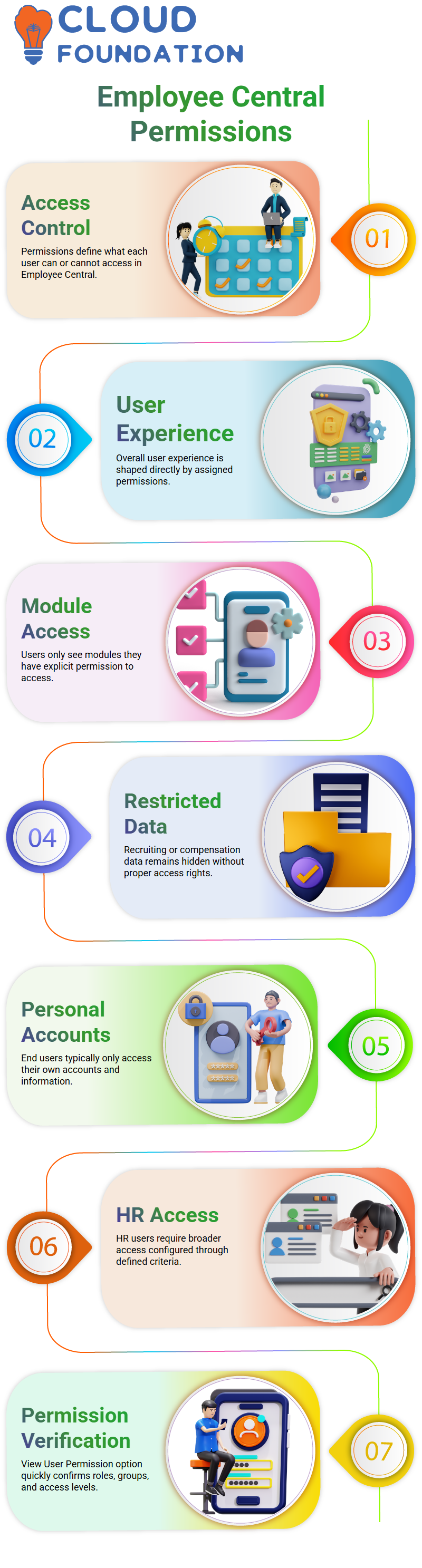
However, HR users need more extensive access, and SAP SuccessFactors Employee Central enables the configuration of such rights via precisely specified criteria.
I always use the same procedures within SAP SuccessFactors Employee Central to verify that a person’s permissions are appropriate for their function whenever I check what they can access.
Verifying User Permissions in Employee Central for SAP SuccessFactors
I immediately resort to the “View User Permission” option in SAP SuccessFactors Employee Central whenever I want to confirm what a user can see. Because it yields the quickest results, I often search by user ID.
After that, SAP SuccessFactors Employee Central shows all of the user’s permissions, including their role, access level, and permission groups.
Because SAP SuccessFactors Employee Central displays several groups and job relationships, the permission information page might sometimes seem confused.
For this reason, I like to utilize SAP SuccessFactors Employee Central’s reporting features to rapidly determine what a person may access.
It saves time and helps me understand the structure of their permits.
Setting Up SAP SuccessFactors Employee Central Permission Roles
I always begin by specifying what the role should be able to read or change when I establish a new permission role in SAP SuccessFactors Employee Central.
For instance, I set everything up in the permission role if I want to provide an HR user access to personal information fields like date of birth, national ID, or job details.
I may choose precisely what the position requires since SAP SuccessFactors Employee Central provides me with a comprehensive list of Employee Central effective data entities.
SAP SuccessFactors Employee Central asks me to specify who will utilize the position once I put it up.
Permission groups are useful in this situation. There are two types: the target group, which comprises staff members the granted group may observe or control, and the granted group, which consists of users who will be given rights.
These two groups are used by SAP SuccessFactors Employee Central to ensure that all permissions function as intended.
Access levels may vary by area, and SAP SuccessFactors Employee Central makes it simple to modify these rights without compromising other groups.

SAP SuccessFactors Training

SAP SuccessFactors Employee Central Permission Groups
To appropriately assign a position in SAP SuccessFactors Employee Central, I construct permission groups once I’ve finished specifying its permissions.
I add an HR user who works with Indian staff to the granted group. The target group is then created to cover all Indian workers.
The HR user may see the precise data they want thanks to SAP SuccessFactors Employee Central, which connects both groups back to the job.
Because they stop unintentional access, permission groups assist me in keeping control over SAP SuccessFactors Employee Central.
A user will not be able to utilize that position in SAP SuccessFactors Employee Central if I do not add them to the granted group.
By providing each department with the resources they need to function well, this structure assists me in avoiding needless risks.
SAP SuccessFactors Employee Central to Manage Permissions
Knowing what workers can view in their own profiles is the first step, I often tell new learners when I work with SAP SuccessFactors Employee Central.
The employee view determines which fields show up on the front end of SAP SuccessFactors Employee Central.
The employee won’t see a field if I don’t provide them access to it. Every workflow, portlet, and event reason in SAP SuccessFactors Employee Central rely on permissions, which is why they are so important.
Every employee profile in SAP SuccessFactors Employee Central is constructed from portlets such as personal information, payroll information, job information, and time off, I always concentrate on the portlets while configuring user rights.
Every SAP SuccessFactors Employee Central portlet requires a unique permission assignment. I only activate the things that someone really needs when I provide them user-based rights. Too little access prevents productivity, while too much access leads to confusion. I find that SAP SuccessFactors Employee Central assists me in finding the ideal balance.
I often emphasize the importance of various permits. Every time we build new MDF object in SAP SuccessFactors Employee Central, various permissions become crucial.
I have to enable view, create, modify, and remove rights here, regardless of whether it’s a custom portlet or any other custom data structure. Whether an item requires rights at all is determined by the security toggle in MDF objects.
SAP SuccessFactors Employee Central wants me to personally assign the rights if I designate it as secured. Users will instantly see it on the front end if I change it to non-secured.
I’ve seen businesses using many methods in actual projects. Permission management in SAP SuccessFactors Employee Central is restricted to one or two individuals in some businesses. Others permit the configuration team as a whole.
SAP SuccessFactors Employee Central Permission Count
The number of permissions may increase rapidly since SAP SuccessFactors Employee Central supports so many modules, including payroll, performance, recruitment, and time management.
However, I mostly deal with effective data permissions, employee data permissions, and employee view rights when a client just utilizes the main SAP SuccessFactors Employee Central module.
Only when there are bespoke MDF items do consultants and administrators manage various rights.
I choose who should be able to read or change the custom portlets I develop in SAP SuccessFactors Employee Central.
Every user in that group may modify the portlet in both their own and other workers’ profiles if I grant them full access to the authorization group.
I often turn off self-editing so users can’t change their own job or pay information. I have clear control over all of this thanks to SAP SuccessFactors Employee Central.
I usually follow a straightforward procedure in SAP SuccessFactors Employee Central when someone asks me whether a person has access to a certain portlet or field. I start by determining which permission groups the user is a part of.
I then check to see whether the necessary field or portlet permission is present in each permission role that has been allocated to those groups.
SAP SuccessFactors Employee Central Miscellaneous Permissions
I go to miscellaneous permissions and activate it for the appropriate group if the permission is absent. This method functions uniformly across SAP SuccessFactors Employee Central.
Almost every day, I create permission groups in SAP SuccessFactors Employee Central. I launch the Manage Permission Groups tool and create groups according to any accessible field, including nation, division, department, location, and legal entity.
For instance, SAP SuccessFactors Employee Central allows me to filter people by nation or region when I establish a group for Dubai employees.
I just choose Doha as the location if I require a group just for Doha workers, and SAP SuccessFactors Employee Central creates the group on its own.
When the group is prepared, I link the permission role to the group by assigning target and granted audiences.
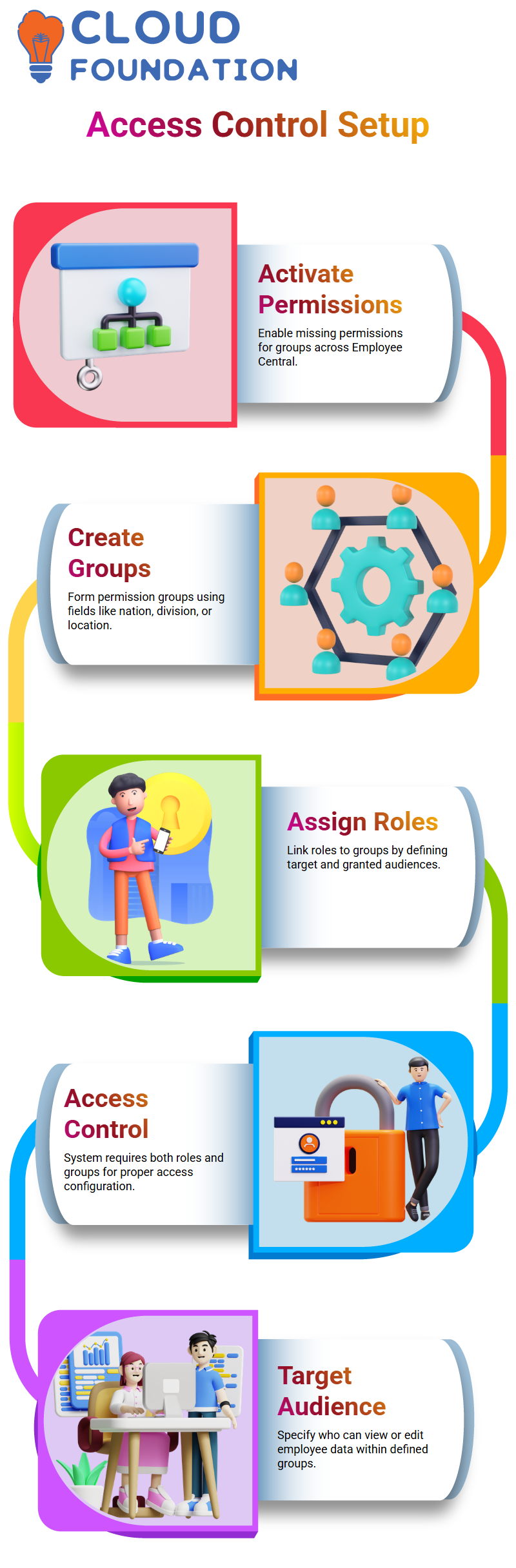
The system in SAP SuccessFactors Employee Central only recognizes a role as belonging to a user when I assign the group.
The role is there without the group assignment, but no one can use it.
To finish the access control configuration, SAP SuccessFactors Employee Central needs both the permission role and the permission group.
I’ve discovered over time that knowing how roles, groups, portlets, and MDF objects interact makes using SAP SuccessFactors Employee Central lot simpler.
I depend on SAP SuccessFactors Employee Central to offer me complete control over what people can see and do whenever I establish permissions.
Setting up SAP SuccessFactors Employee Central permissions correctly becomes one of the most crucial jobs in the system since so many businesses rely on accurate employee data.

SAP SuccessFactors Online Training
Using Employee Central for SAP SuccessFactors Roles and Permission Groups
Permission groups and roles play a major role in controlling who has access to certain employee data when I operate in SAP SuccessFactors Employee Central.
For instance, SAP SuccessFactors Employee Central instantly collected all of the workers from Doha when I set up a permission group for them. After the group completed forming, I saw that it had 17 workers, which served as the basis for the permission arrangement I had to create.
I started with the permitted user assignment after establishing the group.
I had previously developed a role at this point that specified precisely which aspects of the employee profile were editable.
With SAP SuccessFactors Employee Central, I can designate any field that a user is able to change, so the role serves as a guide for what they are and are not allowed to do.
I reopened the role to connect it to the appropriate group once the role and permission group were prepared.
SAP SuccessFactors Employee Central really shines in this situation. In order to let the system know who requires access, I may assign a role to a certain permission group.
When specifying the target audience, SAP SuccessFactors Employee Central provides me several possibilities. I have the option of letting a user see everyone or just a select few. I just choose the designated category if I have a certain target audience in mind.
I made sure the job in SAP SuccessFactors Employee Central referred to the correct mix of target and granted users after selecting the granted user for Doha workers.
SAP SuccessFactors Employee Central Authorized Users
In SAP SuccessFactors Employee Central, I always make sure to prevent the authorized user from editing their own data.
Since users should never alter their personal information while serving as administrators, I set that to “Yes.” This guards against unintentional modifications and maintains system security.
I often create two groups in SAP SuccessFactors Employee Central: one for the permitted users and one for the target demographic.
For instance, I just open the given group, add the new user, then complete the change when someone new joins, like Nelby, who requires the same level of access.
Without having to redesign the whole system, SAP SuccessFactors Employee Central grants them authorization for all Doha workers right now.
Recently, SAP SuccessFactors Employee Central added the ability to provide access for a specified time frame.
This implies that I am able to provide access for a month or any other time frame. Because not all permissions must be permanent, this functionality is quite beneficial.
SAP SuccessFactors Employee Central Group Reports
I sometimes need reports that list the permissions that were in effect for the last three or six months. I may extract reports using SAP SuccessFactors Employee Central according to existing roles and permissions.
I just pick “RBP Permission to User Report” or “RBP User to Group Report” after opening the reporting area and selecting a table report. This clarifies for me how access has evolved over time.
In SAP SuccessFactors Employee Central, I often deal with requests for more access, such as edit permission rather than view-only.
When this occurs, I examine the role and confirm the permissions at the field level, such “business unit” or any other portlet.
The pencil symbol won’t appear in SAP SuccessFactors Employee Central if the user simply has view access.
I modify the role’s permissions to allow them to add, update, or remove entries as necessary.
Assigning the same rights to other users is another often requested feature in SAP SuccessFactors Employee Central, particularly when new hires join a department.
I compare a person’s current permissions using the View User Permissions feature. This is made easy by SAP SuccessFactors Employee Central, which allows me to assign the same position or update the granted group to duplicate access.
SAP SuccessFactors Employee Central Permitted vs Intended Audience
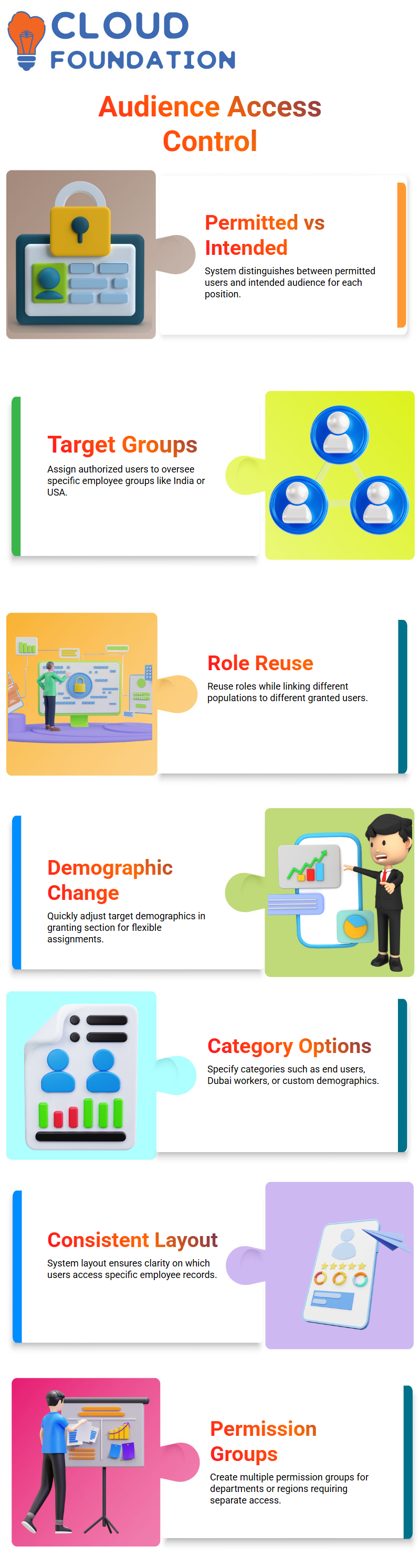
SAP SuccessFactors Employee Central distinguishes between permitted users and the intended audience under each position.
For instance, if the target group is Indian workers, I designate the authorized user to oversee them.
At the same time, if I want a different user to manage USA employees, I add that person inside the same role but link them to a new target group.
SAP SuccessFactors Employee Central lets me reuse the role while assigning different populations to different granted users.
I may quickly change the target demographic in SAP SuccessFactors Employee Central by scrolling down to the granting section.
Here, I specify whether the category consists of end users, Dubai workers, or some other demographic I made up.
SAP SuccessFactors Employee Central keeps the layout consistent so I can quickly understand which users have access to which employee records.
I frequently create multiple permission groups inside SAP SuccessFactors Employee Central because different departments or regions require separate access structures.
For example, India may have one granted user, USA another, and India yet another. SAP SuccessFactors Employee Central handles the distribution of access cleanly.

SAP SuccessFactors Course Price

Vanitha
Author