SAP Ariba Online Courses
SAP Ariba in Procurement
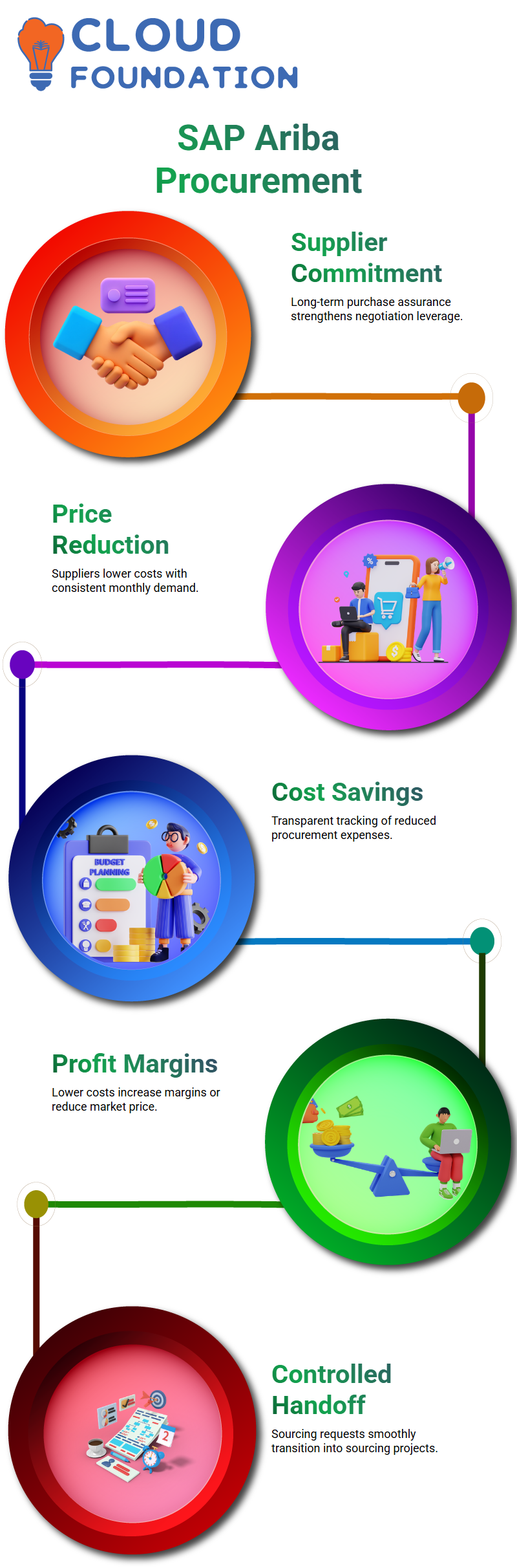
Usually, I begin by being rather explicit with the source. I inform them up front that I am prepared to purchase 100 kilograms each month, or around 1200 kg annually.
I want to be aware that this business is assured. The conversation dramatically shifts when suppliers learn about consistency and long-term dedication.
This type of dedication increases the sourcing agent’s negotiating power in SAP Ariba.
Knowing that I would continue to place monthly purchases, I approached the supplier directly to see if they could offer me a lower price.
Negotiation is made possible by that guarantee, and SAP Ariba is a suitable partner for this methodical approach.
A supplier often lowers the price when they commit to provide 100 kg per month and agree to stock the material.
For instance, the business saves 5 rupees per kilogram if they agree to 20 rupees per kilogram instead of the initial 25 rupees.
SAP Ariba facilitates the transparent and easy recording of these savings.
Profit margins are immediately increased by reduced procurement costs when SAP Ariba takes place.
To remain competitive in the market, businesses may either lower MRP or raise margins. SAP Ariba is intended to enable this real-world procurement situation.
SAP Ariba Sourcing Requests and Sourcing Projects
Let me now go into more detail about sourcing and describe how SAP Ariba organizes this procedure.
The sourcing request and the sourcing project are the two primary documents that are at the center of sourcing in SAP Ariba.
I usually give them a detailed explanation of this since it helps to prevent mistakes later.
The department that requires the material submits the sourcing request in SAP Ariba.
They provide the sourcing team with all item specifications and data. The sourcing project starts when that request gets to procurement.
The sourcing department may then assume responsibility thanks to SAP Ariba.
They gather price and capabilities information and provide quotes to vendors.
One of SAP Ariba’s greatest benefits in actual business situations is this controlled handoff.
Three Ways to Collect Quotations in SAP Ariba
Three distinct methods are provided by SAP Ariba for gathering quotes: RFP, auction, and RFI.
Every approach has a function, and SAP Ariba enables us to choose one depending on business requirements, as I often explain to my Learners.
I often start with an RFI in SAP Ariba when working with a new supplier. All I want to know is whether the provider can fulfill my request.
I wait for their answer after sharing the specs, attachments, and delivery expectations.
The purpose of an RFI in SAP Ariba is not price. Information is the aim. Who is competent and who is not is what I want to know.
SAP Ariba assists me in eliminating vendors that are unable to fulfill the requirements once they have responded.
SAP Ariba RFP Process for Pricing Evaluation
SAP Ariba makes it easy for me to go from RFI to RFP. Here, I only pay attention to vendors that have attested to their ability to deliver.
I ask them to use SAP Ariba to input their price information.
For instance, SAP Ariba allows me to focus on those 12 suppliers without requiring additional work if I invite 20 and only 12 of them qualify following the RFI.
I compile delivery terms, conditions, and prices in one convenient location.
The RFP process is simple with SAP Ariba. Bidding is not competitive here.
I only assess terms and prices. When many vendors provide almost identical quotes, SAP Ariba allows me to proceed.

SAP Ariba Training

SAP Ariba Auctions and Competitive Bidding
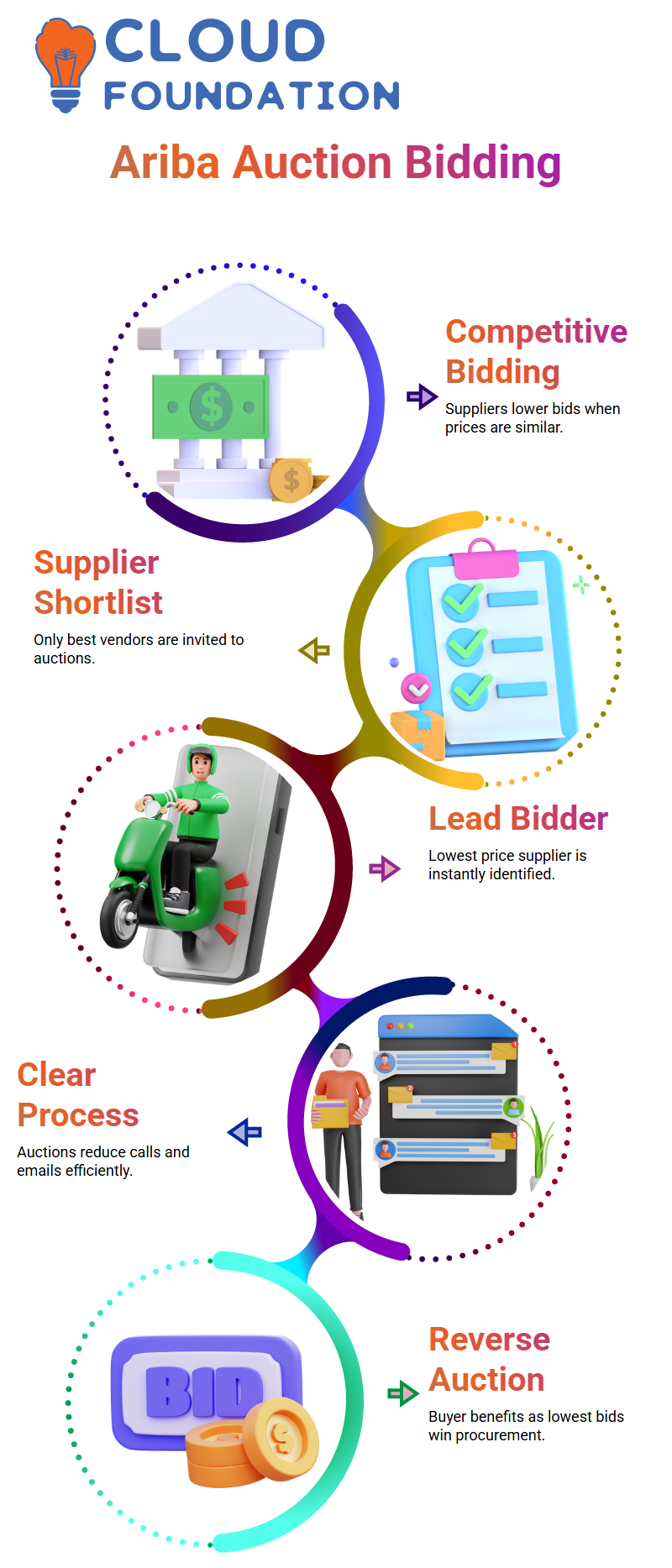
SAP Ariba enables me to hold an auction when vendors’ prices are very similar.
Competitive bidding really comes to life at this point. Typically, I invite the best suppliers to an auction after shortlisting them.
Suppliers compete by decreasing their bids in SAP Ariba auctions, where prices are displayed.
One supplier may rise to 24 rupees per kilogram, and another to 23. I may start at 25 rupees. The lead bidder is immediately identified by SAP Ariba.
Until vendors provide their best pricing, this competition will continue.
With SAP Ariba, the procedure is clear and effective without requiring a lot of phone calls or emails.
SAP Ariba Reverse Auction
In most cases, SAP Ariba auctions are reverse auctions. Every time, I explain why we refer to them as reverse.
Higher bids win in conventional sales. The buyer benefits from cheaper pricing when SAP Ariba for procurement.
SAP Ariba ranks vendors in accordance with price reductions. The lead bidder is the provider with the lowest price.
SAP Ariba auctions are known as reverse auctions because of this inversion of conventional bidding logic.
SAP Ariba Quick Project vs Full Project
Quick project and Full project are the two sourcing project types that SAP Ariba provides.
When I simply want to do one event, such as an RFP or an RFI, I go for a fast project.
In SAP Ariba, a project is finished when a fast project event is finished.
It’s quick and easy. However, I always choose a whole project when I wish to conduct RFI, RFP, and auction simultaneously.
Multiple events may be included in a single SAP Ariba project. Without starting new projects, I may begin with an RFI, go to an RFP, and finally hold an auction.
SAP Ariba Full Project Controls and Approvals
Control is a key component of the SAP Ariba complete project. Tasks, approvals, reviewers, and alerts are all addable.
Additionally, SAP Ariba has a document repository, which is where I save all relevant files.
Another area where SAP Ariba excels is workflow. Approvals may be straightforward for lesser expenditures.
SAP Ariba automatically imposes more stringent procedures for larger expenditures.
For instance, SAP Ariba makes sure that stakeholder meetings, financial validation, IT confirmation, and management approvals are appropriately followed when expenditure exceeds certain thresholds.
Large enterprises utilize SAP Ariba extensively because of its established governance.

SAP Ariba Online Training
SAP Ariba Sourcing Real-Time Projects
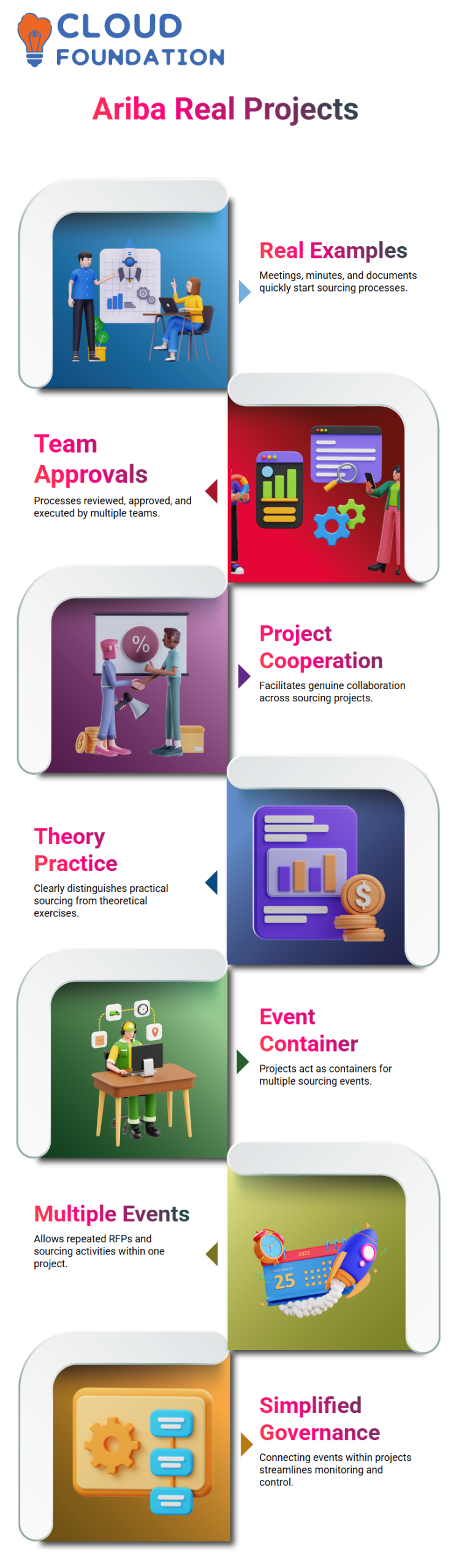
The SAP Ariba procedure may be reviewed, approved, and then executed by different teams.
SAP Ariba facilitates genuine project-based cooperation in this way.
The way SAP Ariba clearly distinguishes theory from practice is what I find most appealing.
I can walk Learners through these processes step-by-step, SAP Ariba, to help them grasp how actual corporate sourcing operates.
How SAP Ariba Handles Multiple Events Within a Project
I often get inquiries about many events within a single project. A project functions similarly to a container in SAP Ariba.
I may repeatedly construct various events, like RFPs, inside a single SAP Ariba project. I am not limited to one sourcing event per project by SAP Ariba.
Additionally, I explain the distinction between organizing an event within an SAP Ariba project and organizing an event outside of it.
SAP Ariba handles events on its own when I generate them without a project.
SAP Ariba connects everything as I create it within a project, which greatly simplifies monitoring and governance.
Exploring SAP Ariba Sourcing Requests and Templates
I provide learners with an overview of the functions of the SAP Ariba sourcing module.
In SAP Ariba, we examine sourcing requests first, then complete projects, and lastly templates.
SAP Ariba templates provide uniformity across projects and save time.
Every time I make a template in SAP Ariba, I create another project to test it. In this manner, I can verify that the SAP Ariba template functions just as anticipated.
Learners may easily identify the differences between fast and complete projects by comparing them side by side in SAP Ariba.
Managing Users, Approvals, and Notifications in SAP Ariba
Questions concerning users are constantly raised throughout training.
Only administrators have access to the user manager in SAP Ariba, which is a component of core administration.
Similar to departments or regions, SAP Ariba views user data as master data.
Notifications and approvals are two more areas where SAP Ariba excels. After a certain number of days, the system may alert management if an approval is still waiting in SAP Ariba.
I can manage this in SAP Ariba by system settings, such as escalation warning periods.
real-world examples, I also describe authority delegation in SAP Ariba.
Delegation only impacts pending permissions in SAP Ariba.
Open items are appropriately transferred to the designated user, while completed approvals stay the same.
This SAP Ariba behavior is indicative of how actual company operations

SAP Ariba Course Price

Nishitha
Author