Workday Integration real-time project training
Workday Integration Release Cycle
Workday Integration adheres to a set release cycle each year. Twice a year, they provide updates.
These versions sometimes introduce new Workday Integration capabilities and occasionally improve existing Workday Integration functionality.
As a Workday Integration professional, I always get ready for this recurring cycle.
Workday Integration grants access to a Sandbox Preview tenant before the production release. I test everything here.
I analyse new Workday Integration updates over this one month, evaluate their impact, and determine whether our current Workday Integration settings need to be adjusted.
Workday Integration Feature Types
Every version of Workday Integration typically includes two types of functionalities.
Features that are immediately accessible are the first kind. All Workday Integration tenants worldwide are able to use these capabilities.
I don’t have to manually activate them. They are live for every organisation once Workday Integration pushes them.
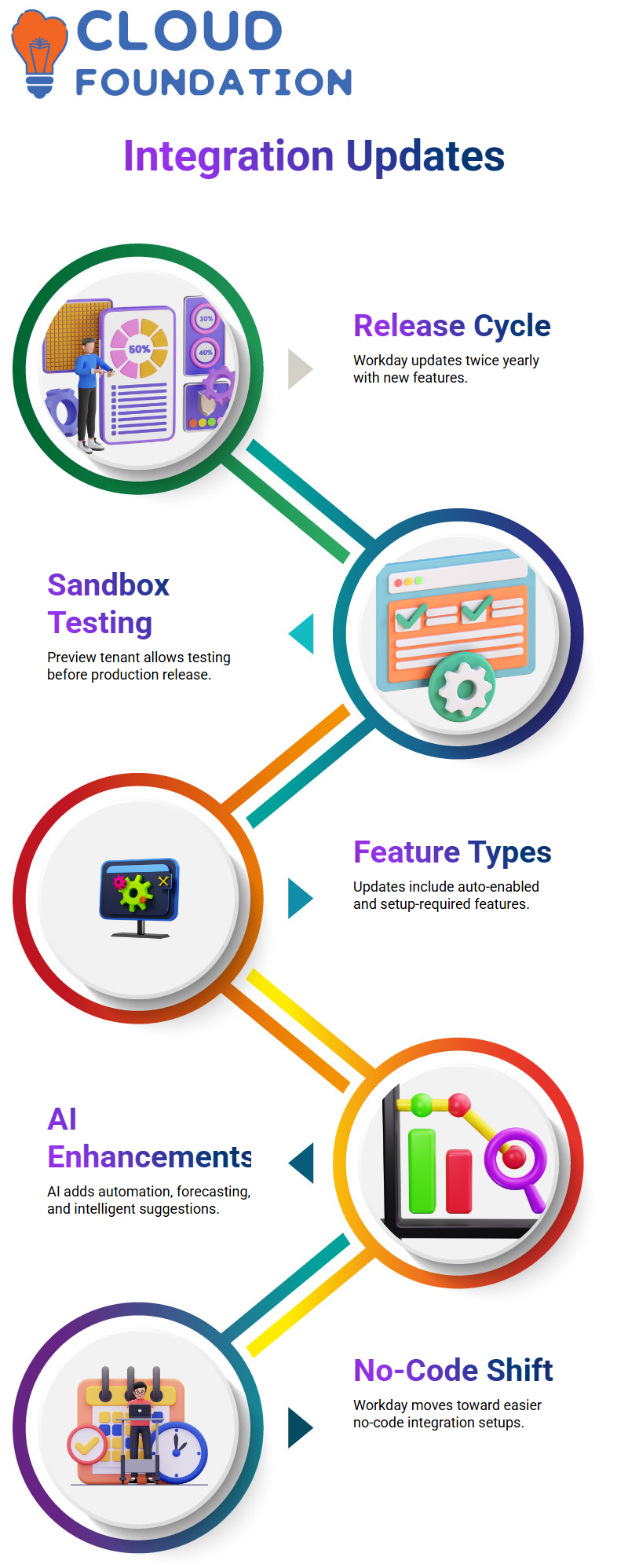
The second kind is establishing needed characteristics. In this instance, Workday Integration provides thorough documentation and videos outlining how to activate the capability.
Here, I need to carefully review the guidelines and determine whether our business would benefit from enabling the Workday Integration function.
Working with Workday Integration requires one of these two kinds since each category has a different effect and preparation method.
AI in Workday Integration and the Shift Toward No-Code
Every product on the market now incorporates AI in some way. This also applies to Workday Integration.
AI may be found in Workday Integration in various forms, including automation, forecasting, skills intelligence, and intelligent suggestions.
For instance, AI and machine learning are already included in Workday Integration skills management.
When I add a new skill to Workday Integration, the system intelligently looks for existing talents that are comparable and integrates them if needed.
That is AI operating in the background of Workday Integration.
The shift to no-code setup is another significant trend in Workday Integration.
Workday Integration formerly used an 80% configuration and 20% coding methodology.
With solutions such as orchestration for integrations, Workday Integration is moving even closer to no-code.
These features make Workday Integration development easier and less reliant on complex code.
In my opinion, these technologies reduce the need for Studio in many Workday Integration scenarios rather than replacing it entirely, even though some people compare them to Studio.
How I Handle Change Impact in Workday Integration Projects
Every time I learn of a change in a field, report, or online service, I instantly consider how it would affect my Workday Integration environment.
For instance, I don’t freak out if a field is deprecated. Rather, I begin mapping that modification to any Workday Integration that may make use of that field.
At the moment, I oversee hundreds of Workday Integration processes.
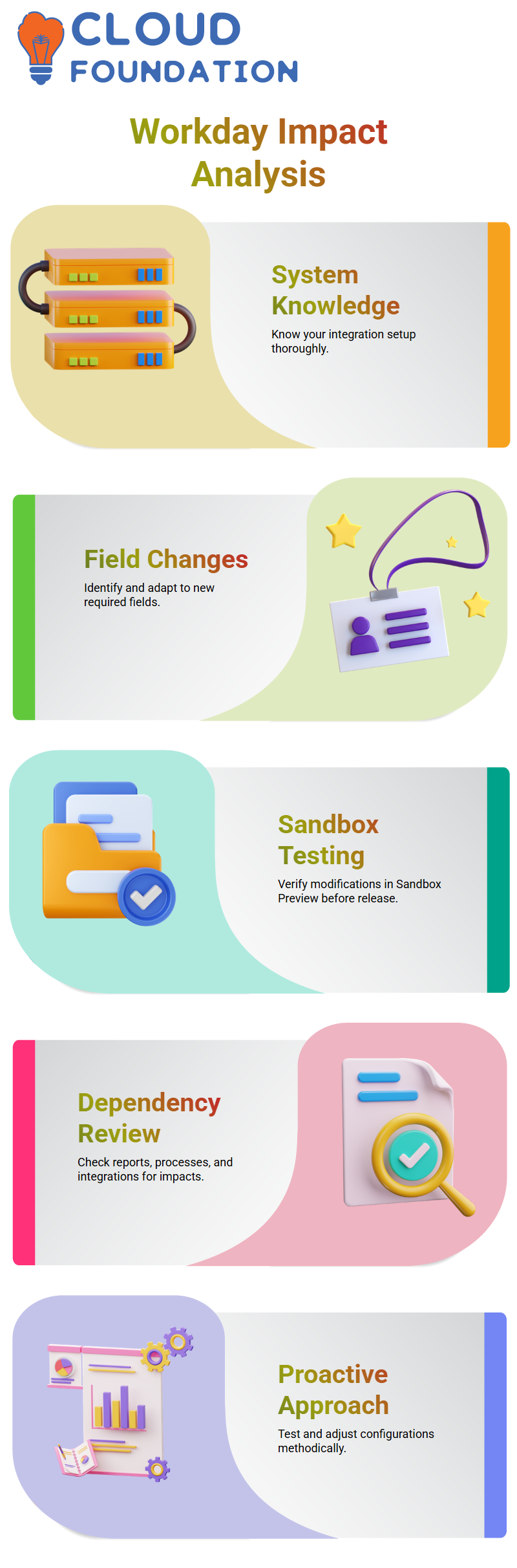
I can immediately identify which Workday Integrations may be impacted since I have a functional of each one.
Perhaps only ten of the fifty integrations deal with time-off data. Perhaps just two of the ten Workday Integration configurations make use of the affected web service.
Once I identify the damaged Workday Integration components, I quickly proceed into investigation and testing.
I use Sandbox and Sandbox Preview to test any impacted Workday Integration.
I can tell that a release update has affected the Workday Integration if I see a difference in outcomes between the two environments.
I receive from that comparison before the manufacturing process even begins.
Why Every Workday Integration Matters
My ability to react fast during requirement calls has been honed by experience.
I mentally go through my whole Workday Integration inventory whenever someone introduces a new feature or vendor relationship.
I can quickly identify the Workday Integration flows that might be related to that modification.
This degree of consciousness is not accidental. Every Workday Integration I oversee is deliberately studied by me.
I am aware of the Workday Integrations that manage payroll, benefits, time tracking, and external suppliers.
I lower risk during releases because I create that mental map.
I start by applying a high-level filter when a change occurs. I then go more into each Workday Integration that could be affected.
Lastly, I pinpoint the precise Workday Integration that requires adjustment and concentrate only on resolving it. This methodical approach preserves stability and saves time.

Workday Integration Training

How I Approach a New Workday Integration Project
I review all available documentation for each Workday Integration. I research transformation logic, field mappings, and data flow diagrams.
I don’t wait for help if there’s no documentation. I launch every Workday Integration straight from the system.
I follow the flow step by step. I examine each Workday Integration’s source, transformation logic, and destination delivery method.
Then I create my own documentation as I learn.Many organisations implement Workday Integration solutions through contractors.
Occasionally, such contractors depart without keeping accurate documents.
I approach the Workday Integration environment as a learning exercise in such situations.
I record everything, reverse-engineer the logic, and create clarity from the ground up.
Design Documentation in Workday Integration Lifecycle
I adhere to the distinct stages of research, design, build, and test in every organised Workday Integration project.
During the design phase, documentation plays a major role in shaping the Workday Integration outcome.
For a Workday Integration design, I typically create two main papers.
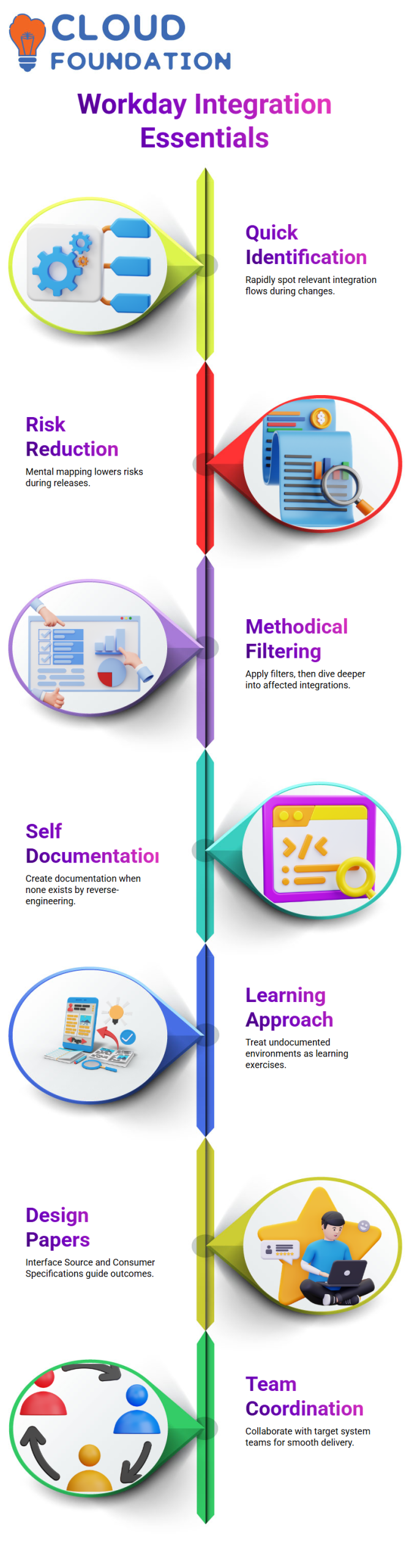
The first is the Interface Source Specification, which specifies how data is extracted and transformed from Workday via the Workday Integration.
In the second, I outline how the target system will use the Workday Integration output in the Interface Consumer Specification.
For instance, Workday serves as the source when I create a Workday Integration with an external expenditure system.
I specify exactly which fields the integration pulls, how I change them, what format I create, and how I transmit the file in the Workday Integration document.
To ensure their portion of the Workday Integration correctly receives and processes data, I coordinate with the target system team simultaneously.
Designing Workday Integration
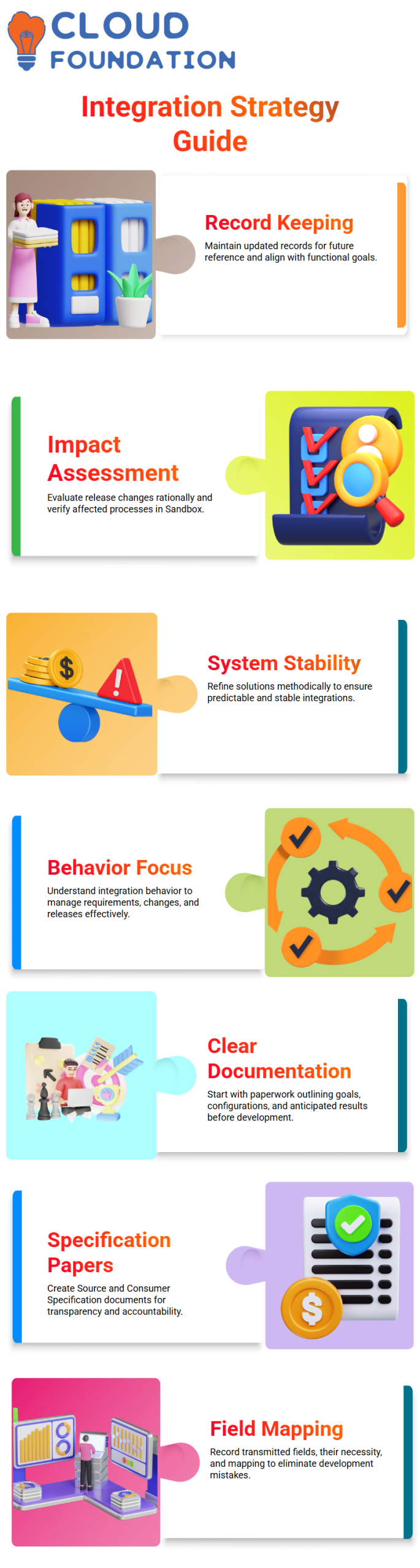
I never proceed directly to development when I begin a Workday Integration project. I start with the paperwork.
I outline the change’s goal, the Workday Integration’s goal, the business aim, and the anticipated result at a high level.
I meticulously record the field mapping, delivery configuration, technical configuration, security configuration, and functional configuration.
Everyone involved can easily understand the Workday Integration with this methodical approach.
I produce two key papers for each Workday Integration. I drafted the Source Specification paper from Workday.
The external team creates the Consumer Specification document from the consumer system’s perspective.
The Consumer Specification describes how the receiving system will utilise those fields, while the Source Specification describes what Workday Integration sends out.
Because of this division, the Workday Integration is transparent and responsible.
For instance, if Workday Integration transmits 10 fields to a different system, I record precisely which 10 fields are being transmitted, why they are necessary, and how they are mapped.
The consumer system team simultaneously records their expectations for the Workday Integration and their plans to develop those fields in their system.
This clarity eliminates mistakes during development and testing.
Source and Consumer Roles in Workday Integration
Depending on the direction of data transmission, the roles of source and consumer in Workday Integration vary.
Workday Integration serves as the source when data is sent from Workday to Concur.
In such a scenario, the Concur team develops the Consumer Specification document while I write the Source Specification document from the Workday Integration side.
Workday Integration becomes the consumer if the flow is reversed and data is sent from Concur to Workday.
In such a case, Workday Integration does not generate a Source Specification. Rather, I concentrate on the relevant consumer documents, such as IACS.
Every Workday Integration requires of this role transition, as documentation depends solely on who owns the source and who uses the data.
Every time I work on Workday Integration, I ensure that everyone’s roles are well-defined. This approach prevents gaps, particularly when many teams work together across platforms.
Workday Integration Online Training
Building and Testing Workday Integration Step by Step
Once I finish the first set of Workday Integration design docs, I will treat them as drafts. I often find issues during construction that I was unaware of while designing the solution.
That’s typical. As I go from theory to practical development, Workday Integration becomes more apparent.
The Workday Integration development phase is known as the construction phase. I go into testing after development.
I do user acceptability testing, system integration testing, and unit testing throughout this phase.
The Workday Integration is validated from several perspectives by each testing layer. I check data correctness, business rules, security roles, and field mappings.
I don’t complete the Workday Integration docs until after extensive testing.
To ensure the docs accurately reflect the implementation rather than just the initial concept, I incorporate any modifications into the final version of IACS.
Deploying Workday Integration with Runbook and Transition Documents
The last stage of Workday Integration’s operation is deployment. I manage tenant transitions here.
I create a thorough runbook before deployment. Every step required to install the Workday Integration is documented in the runbook.
Sequencing, validations, and rollback concerns are all included.
For the Workday Integration, I also drafted a transition paper.
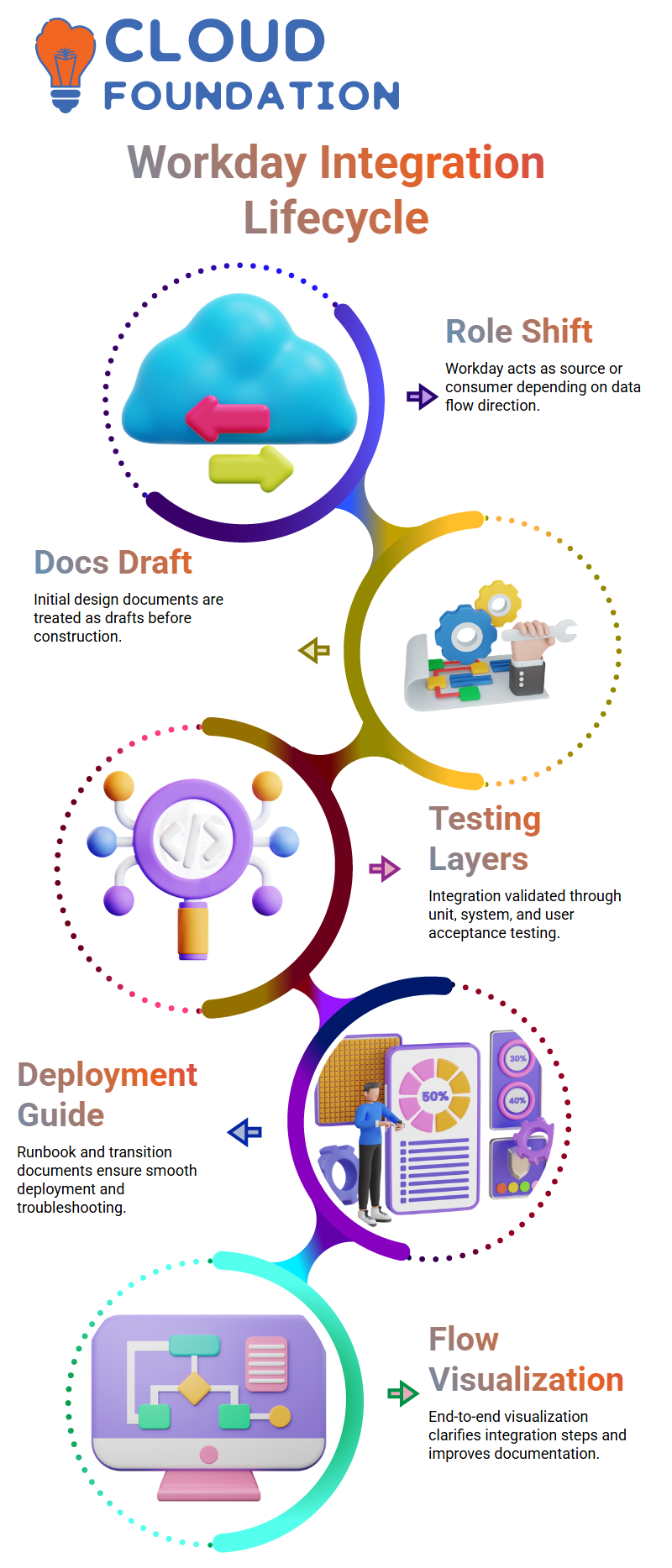
I document configuration modifications, known issues, manual launch procedures, and common troubleshooting scenarios in this document.
The transition guide should be easy for anyone to follow if they need to execute the Workday Integration manually.
I ensure the project doesn’t rely on a single person by maintaining up-to-date Workday Integration documentation.
Anyone in the team can understand what was done and how it works.
Visualizing End-to-End Workday Integration Scenarios
Before or during installation, I usually advise visualizing Workday Integration on paper.
Let me explain with a simple example. Let’s say a new employee joins the organisation, and Workday is updated with all employee information.
For the employee to log in and submit a reimbursement claim, certain fields are sent to Concur via the Workday Integration.
In this case, Concur receives the necessary employee data via Workday Integration. Concur identifies the employee with that information.
The reimbursement process is seamless when the employee logs into Concur after returning from vacation, since the Workday Integration has already synced the necessary data.
I can see the full Workday Integration picture when I sketch the entire flow.
I can see the beginning, middle, and end of the data. This end-to-end visualisation greatly enhances the quality of the Workday Integration.
I’ve worked with several customers and found that very few experts maintain Workday Integration documentation at this level of detail. Many individuals follow the instructions they are given.
On the other hand, I provide Workday Integration openly and excellently when I keep organized documentation, flowcharts, and mapping clarity.
I advise integration developers to take charge of Workday Integration design even in the absence of a specialized architect.
I learn more and develop solutions in an organized manner when I directly manage the whole Workday Integration lifecycle, from documentation to implementation.

Workday Integration Course Price

Vanitha
Author
The capacity to learn is a gift; the ability to learn is a skill; the willingness to learn is a choice