Tosca Course Online
ERP Fundamentals in Tosca
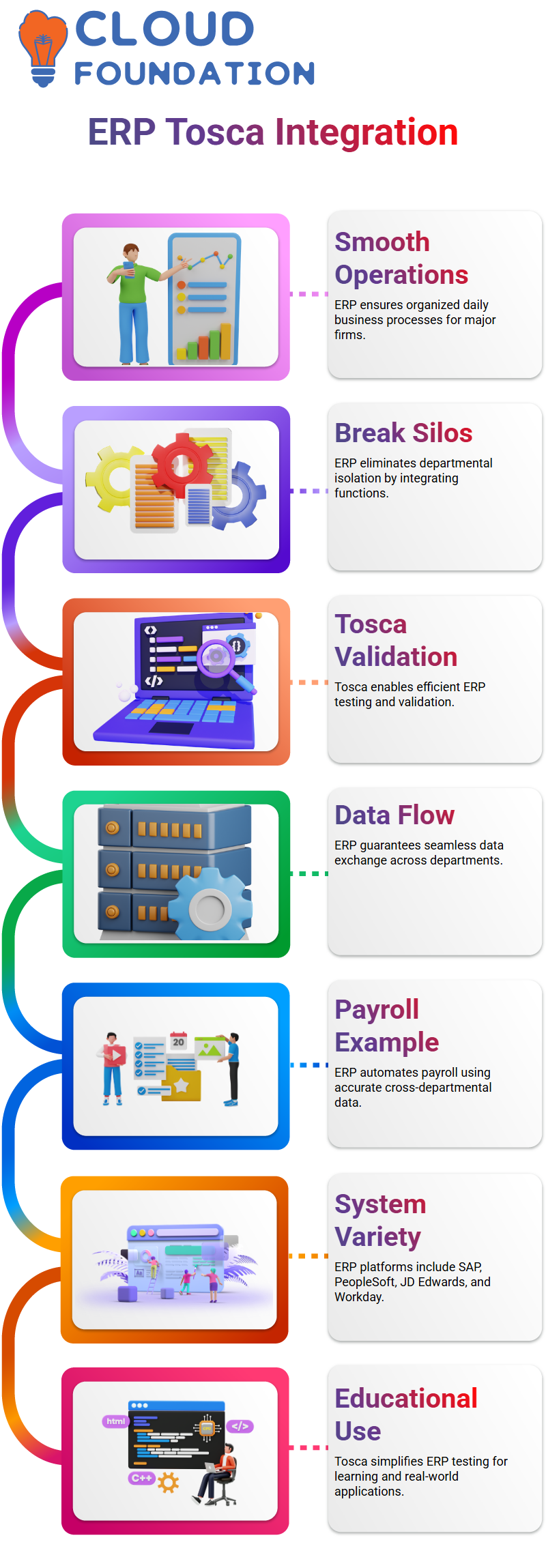
ERP is essential to the smooth and organized daily operations of any major firm.
I’ve seen how departments operating in silos cause problems for corporations, and ERP is the perfect solution in this situation.
I often use Tosca to illustrate ERP ideas since it facilitates the efficient validation and testing of these complex systems.
Finance, supply chain, marketing, and human resources are just a few of the departments found in every firm.
If the company desires steady development, these divisions cannot operate on their own. ERP guarantees smooth data flow by integrating all of these departments.
Tosca assures us that these integrations function as intended across the system, which is why I always highlight them when I explain this idea.
Why Organizations Depend on ERP and Tosca for Reliability
In my experience, integration is the main advantage of ERP. Without human interaction, data is sent between departments.
The greatest example I offer my Learners is payroll. Each person is paid for their labor, and payroll relies on precise information from many departments.
ERP does this seamlessly, and Tosca guarantees error-free end-to-end testing of payroll procedures.
Many ERP systems, including SAP, PeopleSoft, JD Edwards, and Workday, are now on the market.
During seminars, I personally pay more attention to Workday and constantly relate it to Tosca testing procedures.
Tosca is perfect for educational settings and real-world applications since it enables us to test complicated ERP situations without creating a lot of code.
Cloud-Based ERP with Tosca Perspective
In the past, businesses had to keep up with databases, applications, and web servers.
Time, money, and expert resources were needed for it. All of it is now eliminated by cloud-based ERP.
Since Tosca is built to effectively serve cloud apps, I naturally bring it up when I discuss cloud ERP.
Workday is a web-based, cloud-based program. All that is required of organizations is a subscription; the supplier handles everything else.
The way we test apps is altered by this simplicity. I demonstrate how cloud testing is simpler, quicker, and more dependable with Tosca than with conventional testing methods.
Workday Configuration Basics Alongside Tosca Testing
I dispel the widespread misconception that Workday needs extensive programming expertise. In actuality, Workday prioritizes setup above code.
Everything is seen as an object or data source since it employs object-oriented principles.
Tosca becomes my go-to example for verifying setups without requiring a great deal of technical know-how when I explain these ideas.
Workday enables you to configure calendars, organizational structures, and business processes, just way you may customize your Google account settings.

Tosca Training

Organizational Structures Explained with Tosca Examples
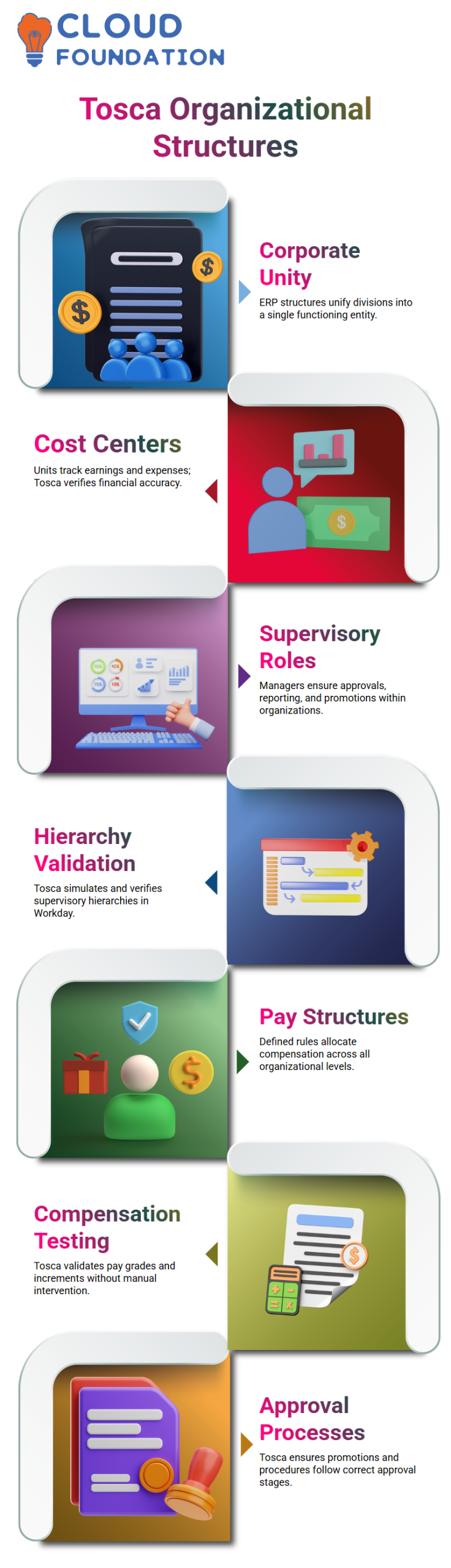
Knowing the structure of the firm is crucial while deploying Workday. I often use major corporations as instances in which many corporate divisions function as a single entity.
Every unit keeps track of its own earnings and outlays. Here, cost centers are crucial. I illustrate how Tosca may verify financial and reporting correctness while describing cost centers.
Another crucial idea is supervisory organizations. A manager or supervisor is required for each business unit.
This structure is necessary for approvals, reporting lines, and promotions. Tosca assists us in simulating actual organizational situations and verifying that Workday’s supervisory hierarchies operate as intended.
Compensation and Business Processes Through Tosca Lens
Pay structures specify how pay is allocated for all positions, from the CEO to entry-level workers.
Clear guidelines must be followed for pay grades, levels, and increments.
I go over these ideas in detail and consistently demonstrate how Tosca can test compensation rules without requiring human intervention.
Promotions and other business procedures need many approvals. A promotion is proposed by a manager, reviewed by HR, and approved by senior leadership.
These processes must run flawlessly. By verifying each permission stage and making sure the procedure proceeds without violating system regulations, Tosca plays a significant part in this process.
Enterprise Workflows with Tosca in Real Projects
Nothing is directly implemented in the majority of enterprises. Every modification is reviewed, approved, and validated, often by leadership or HR teams.
When I connect this to Tosca, I emphasize how Tosca enables us to evaluate these processes not as perfect diagrams but rather as they are in real life.
Since this is how Learners relate theory to practice, I often provide screenshots and real-world examples.
As business procedures go from “in progress” to “approved,” Tosca enables us to verify each stage without relying on conjecture.
Learning Tosca makes it easier to observe how automation blends in with corporate systems and business approvals.
I explain to them that Tosca is a tool for how apps function inside businesses, not simply for testing.
Once you map and verify it in Tosca, every process, approval chain, and system interface becomes more understandable.
Application Configuration Through Tosca
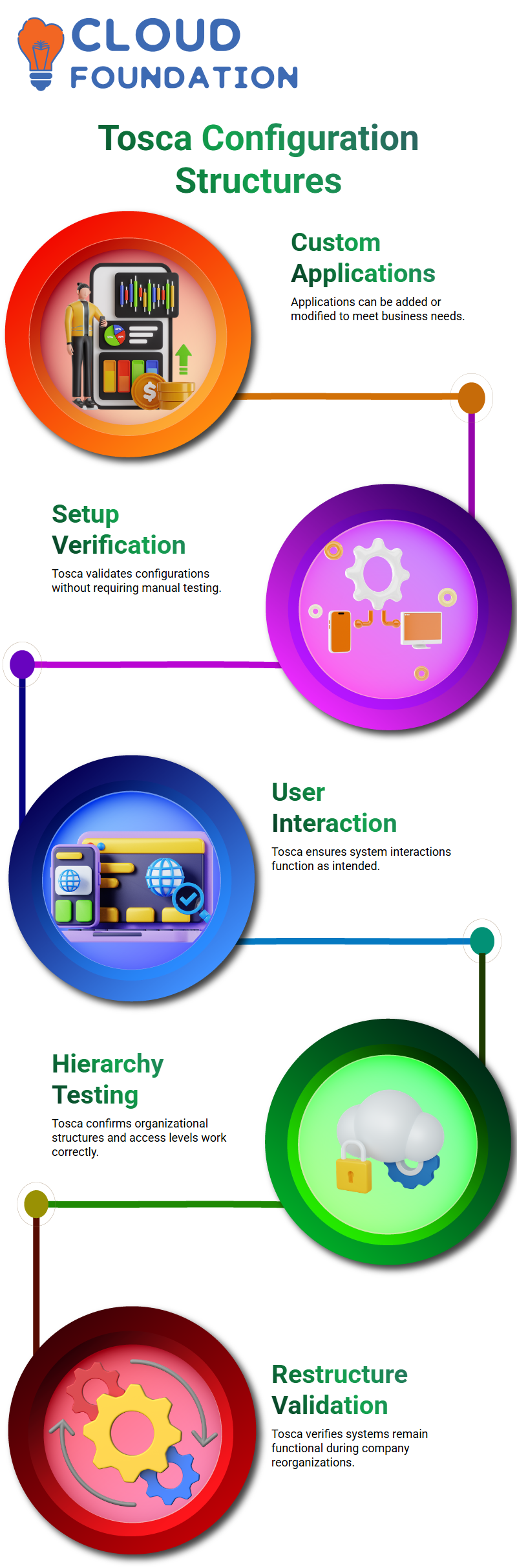
I often refer to corporate catalogs as application areas that may be customized. Applications may be added, settings can be changed, and they can be matched with business requirements.
I describe how Tosca verifies these setups without the need for manual tests when I introduce it to the conversation.
Because Learners often get confused by terminology, I also discuss worklets and workbenches during instruction. I keep it simple and connect it to Tosca.
Tosca focuses on how users interact with the system and if those interactions function as intended, regardless of the name of the interface.
I want Learners to feel comfortable with corporate technologies while I offer free technology classes.
Tosca fills that need. Tosca lets you test those pathways frequently, consistently, and without worrying about destroying anything once you grasp navigation and setup.
Tosca Online Training
Organizational Structures via Tosca Examples
Before we go into systems, I normally ask Learners to visualize a corporate organization.
The CEO is at the top, followed by vice presidents, executive management, managers, senior managers, and employees.
It is simpler to see how testing fits with hierarchy and access when I relate this structure to Tosca.
Departments such as finance, human resources, operations, sales, and marketing are present in any firm.
There are sub-structures within these departments. I clarify that Tosca aids in confirming that users at every level are only able to access the information that is intended for them.
Testing becomes crucial when companies reorganize. Tosca excels in this situation.
Tosca enables teams to confirm that the system continues to function properly upon restructuring, regardless of department mergers or changes in reporting lines.
Locations, Roles, and Security Testing with Tosca
In actual implementations, I usually emphasize that businesses have many locations.
Workers may be located in many nations, areas, or workplaces. I describe how Tosca assists in testing location-based settings to ensure that workers see the appropriate information according to their workplace.
I also place a lot of emphasis on organizational duties. For instance, a finance head needs access to private financial information.
We can confirm that just the appropriate roles have the appropriate permissions and nothing more with Tosca.
When you learn Tosca correctly, security and access control are not abstract concepts.
I urge them to picture actual users of the system. Tosca enables us to test roles, responsibilities, and security in a manner that is representative of how businesses really operate.
Learning Enterprise Thinking Through Tosca Practice
I am aware that the majority of Learners I teach are unfamiliar with ERP systems.
I take my time, going over ideas methodically and connecting them all to Tosca. My objective is comprehension rather than memorization.
I often advise Learners to see how a business operates, how choices are made, and how those decisions are supported by processes.
Tosca turns into a clear lens through which people see corporate systems. Learners learn to think like experts by working with Tosca.
They begin validating instead of speculating. With each Tosca session I lead, I try to cultivate that mentality change.

Tosca Course Price

Nishitha
Author