SAP Field Glass Online Classes
Sap Field Glass: Managing Discounts and Supplier Permissions
Every time I deal with Sap Field Glass, I make sure the discount is specified in the S4W. I wonder whether we can accept more than one supplier and currency.
According to my observations, approval of S4W revisions is only necessary when the maximum budget rises.
Since SWW revision approvals support internal control over each change, I advise maintaining them in place.
I often set ‘Allow suppliers to initiate a statement of work revision’ to no in SAP Field Glass.
Revisions should be made by buyers, not providers.This guarantees responsibility and clarity.
That is precisely how I handle it in Sap Field Glass, where SWW modification approval is immediately prompted once the maximum budget increases.
Sap Field Glass: Supplier Controls and Event Management
Since suppliers service a particular site, which may have several locations, I let them provide precise specifics on the line afterwards.
I usually advise turning on auto-invoicing for billable projects, expenditures, and timesheets in SAP Field Glass.
I ensure that suppliers cannot increase amounts before invoicing, although they may reduce them if the company policy allows.
With Sap Field Glass, it’s simple to create numerous events from a single event. Since each event is important to the customer and makes their job easier, I let suppliers handle sub-events.
In order to facilitate the tracking of deliveries for both the provider and the customer, I additionally allow hierarchical events.
Sap Field Glass: Holdbacks and Template Configurations
I often set Holdback to nil in SAP Field Glass. If businesses expect to need to keep back SOW levels, they could decide to say yes.
Sap Field Glass allows you to easily control all template locks, hiding and unhiding options, and form customisations.
I often inherit templates from master SWW templates, and I personally take great care while defining SWW names.
This is useful for developing general-purpose SOWs or various projects. I make sure that descriptions may be made public or locked as necessary.
The name field cannot be hidden and is always required. Plans, various classes, and buyer references are all customizable.
I also closely monitor accounting controls, such as establishing visibility restrictions in SAP FI-GL, locking budgets, and maximum budgets.

SAP Training

Sap Field Glass: Rules and Approvals
I established explicit guidelines for SOW procedures in SAP Field Glass. I specify which components vendors can see, edit, or submit.
Users are able to report absences, for instance, but visibility and locking are strictly managed according to business needs.
To keep the S4W name and descriptions safe, I always check that creator permissions are set appropriately.
Every time I examine SAP Field Glass templates, I consider every regulation, including those about approver selection, user fees, and supplier budget suppression.
Implementation is made easier by being aware of these regulations.
To ensure that everyone on my team is aware of what to lock, conceal, or permit, I often lead them through SWW template settings.
Sap Field Glass: Functional Understanding for Implementation
I find that comprehending the functional requirements of SAP Field Glass is more difficult than making templates.
I work with juniors and buyers to make sure the SOW procedure is understood.
While juniors learn how to handle templates and approvals, seniors supervise execution.
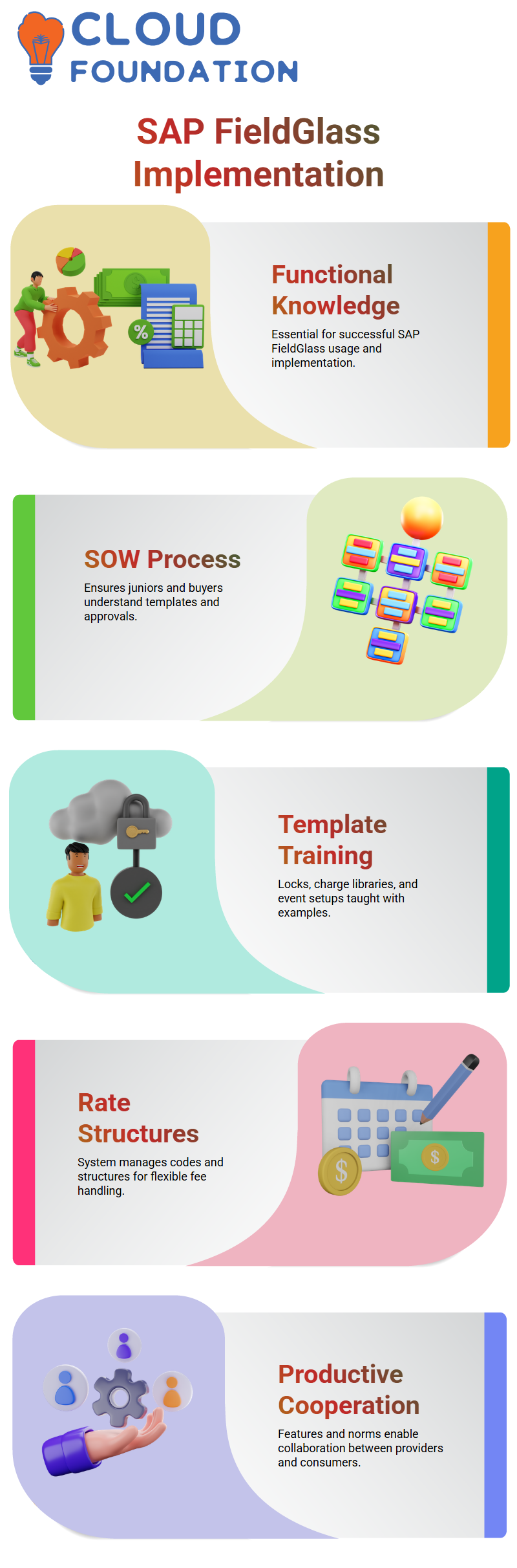
For Sap Field Glass to be used successfully, this functional knowledge is essential.
I often teach locks, charge libraries, and event setups using examples of typical SAP Field Glass templates.
It becomes easy to use SAP Field Glass if you understand these terms.
Every stage, from setting up features to establishing norms, facilitates productive cooperation between the provider and the consumer.
Understanding SAP Field Glass Rate Structures
You’ll observe how the system manages rate codes and rate structures when I first demonstrate SAP Field Glass.
Businesses that use SAP Field Glass’s tariff structure do not depend on the fees library.
Rather, customers choose the fee structure that best suits their needs.
After you’ve been chosen, the technology helps you effectively handle fees and events in SAP Field Glass.

SAP Online Training
You may keep up a management event library using SAP Field Glass. This may be configured based on the needs of your business.
The questions library operates similarly. You develop unique questions for the SWW bid in SAP Field Glass.
This guarantees that the author may immediately enter the query and get prompt responses when the bid is placed.
In order to streamline the process and save time, SAP Field Glass even allows you to pre-build common questions.
Roles and Suppliers in SAP Field Glass
You can plainly see the various SW worker jobs in SAP Field Glass. Specific vendors are needed to support each position.
You may build a position in SAP Field Glass and add the relevant suppliers to it.
This guarantees that all roles are covered and that the system is aware of who is in charge of what.
This is effectively handled by SAP Field Glass, which simplifies and organises role administration.
Creating Schedule Libraries in SAP Field Glass
You may construct a schedule library with SAP Field Glass if your organisation employs schedules. Schedule-based payment arrangements may be set up for suppliers.
When it comes to events, fees, or calendar management, SAP Field Glass guarantees your freedom.
SAP Field Glass easily adjusts to the functionality that the purchasing firm chooses to employ.
Configuring the SWW Module in SAP Field Glass
You ought to be well aware of how SAP Field Glass’s SWW module works at this point. We looked at key roles, configuration procedures, and fields that need setup.
You may immediately get practical experience using SAP Field Glass. The fundamental features of SAP Field Glass are the same regardless of how any business implements it.
Overall, SAP Field Glass has a consistent structure across enterprises, while certain bespoke features may differ.

SAP Course Price

Vanitha
Author