Online Course on NetSuite Functional Module
Accounts Receivable in NetSuite
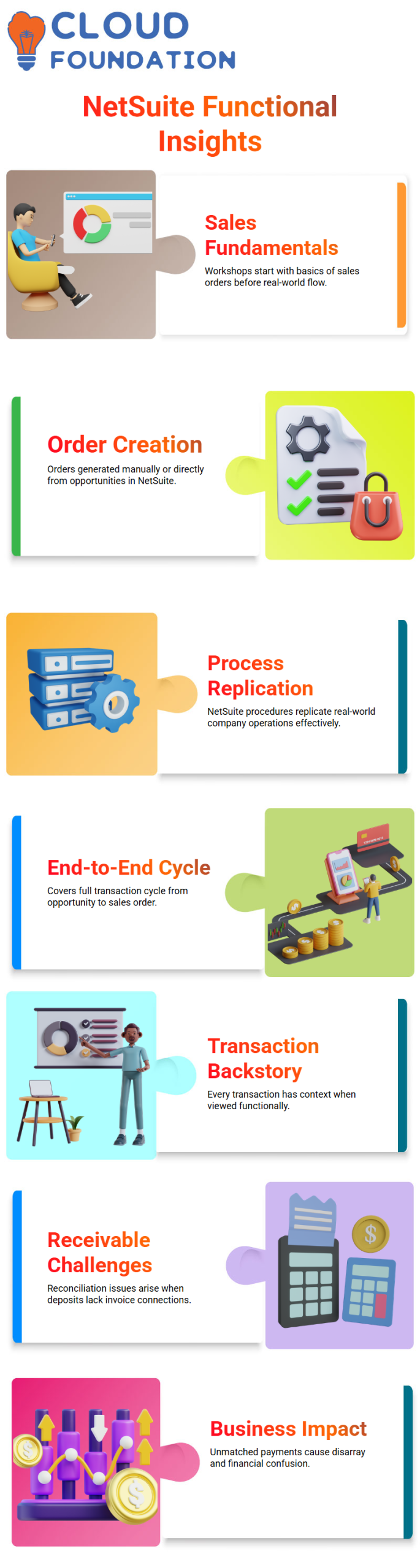
Accounts receivable reconciliation is a question I frequently hear in every NetSuite class. As a NetSuite trainer, I encounter this issue frequently: clients deposit money into the bank, but finance departments are unsure of which invoice the money is associated with.
From a NetSuite perspective, this leads to disarray in the process of reconciliation. One of your customers may receive an invoice from you, but someone else pays them. Businesses suffer because, in NetSuite terms, the money is there, but there is no connection to the invoice.
Exploring Payment Tools using NetSuite
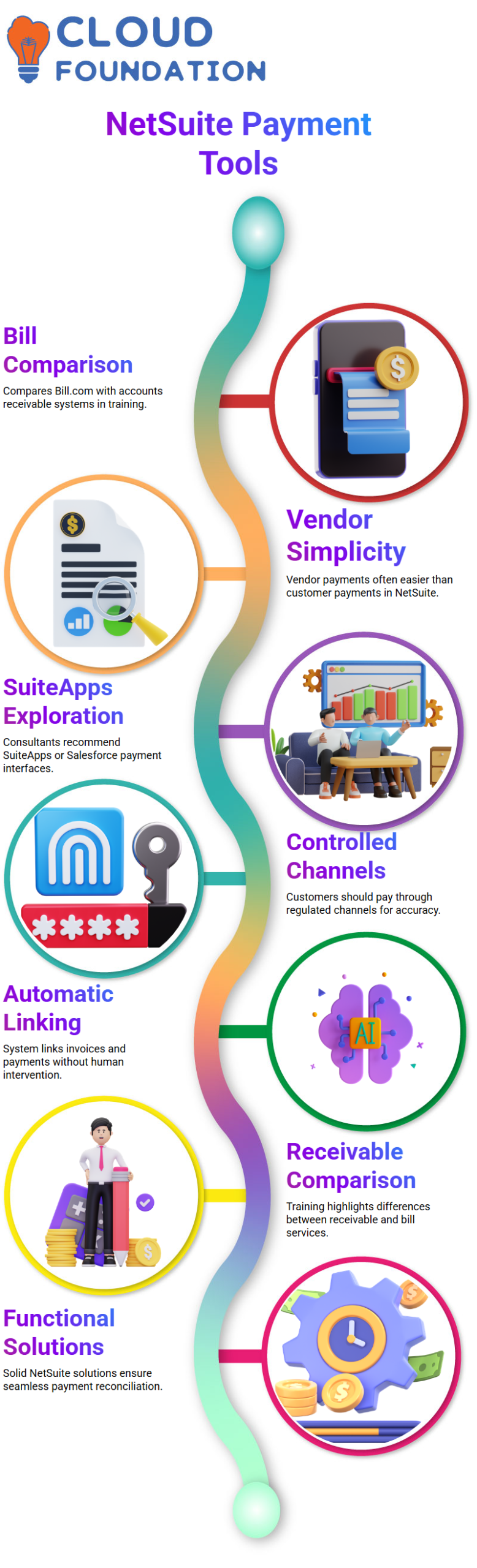
I frequently contrast bill payment platforms like Bill.com with accounts receivable systems in my NetSuite presentations. This comparison aids Learners in knowing why managing vendor payments seems simpler than managing customer payments during NetSuite training.
I typically advise looking into SuiteApps or interfaces like Salesforce payments as a NetSuite Consultant. In order for the system to automatically link the invoice and the payment without human intervention, a good NetSuite solution should require the customer to pay through a regulated channel.
Role and Access Control in NetSuite
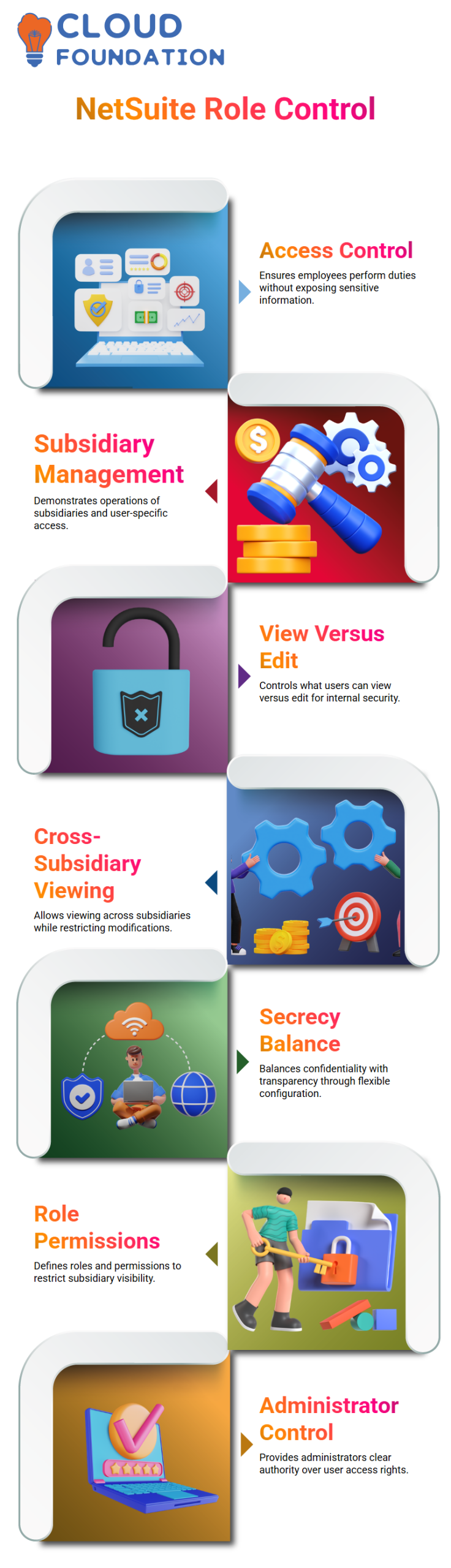
Since it addresses actual business issues, access control is one of my favorite NetSuite subjects. I am aware that businesses prefer that workers perform their duties without disclosing private information such as wages or severance benefits.
It includes operations of subsidiaries, user subsidiaries, and selected subsidiaries in NetSuite role management. Controlling what users can view versus edit is essential for internal controls, and it is possible with a NetSuite configuration.
You can even prohibit modifications while permitting cross-subsidiary viewing from a NetSuite security perspective.
Because of this flexibility, I usually emphasize that having a functional NetSuite offers you the ability to strike a balance between secrecy and transparency.
Role Control in NetSuite
NetSuite automatically restricts a user’s visibility to that subsidiary and only that subsidiary if I assign them to it. They are not allowed to look into other subsidiaries.
But I have far more control with NetSuite than just subsidiary limitations. I have complete control over what the user is allowed and not allowed to do within that subsidiary.
This is where administrators who desire unambiguous access control might benefit greatly from NetSuite.
Restricting Transactions in NetSuite
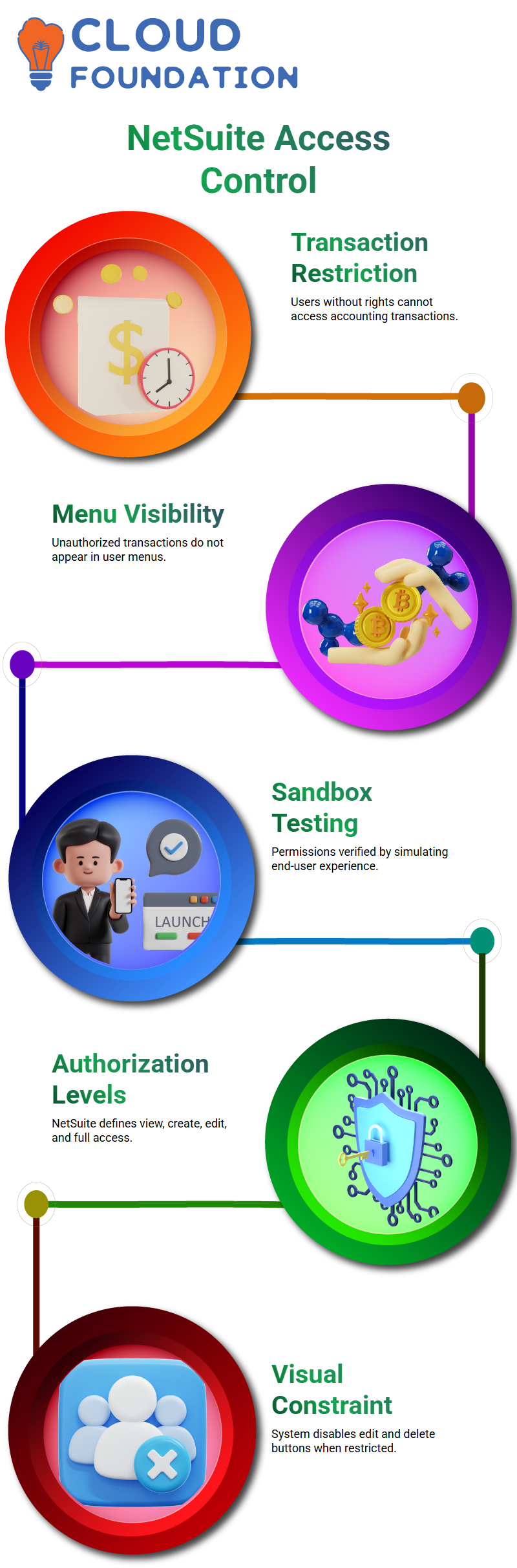
What if a user is a subsidiary but shouldn’t have access to accounting transactions? This is handled neatly by NetSuite. Purchase orders, journal entries, vendor payments, and customer receipts are examples of transactions for which I merely delete transaction rights.
If I don’t give authorization, the transaction in NetSuite doesn’t even show up on the menu. The user is unable to view payment screens, publish journals, or enter purchase orders. For this reason, I constantly emphasize to Learners that NetSuite access control is accurate rather than complex.
I test this in the sandbox when I work directly with NetSuite. I take on the role of the end user and see exactly what they will see. I can verify all of the NetSuite permissions before going live thanks to this method.

NetSuite Functional Training

Permission Levels in NetSuite
I keep saying this because it’s important: NetSuite defines four distinct authorization levels. View access in NetSuite lets users view records without making any changes. They can add records with create access, but they can’t change ones that already exist.
Viewing, creating, and editing are all possible with edit access in NetSuite, but deletion remains locked. Everything is accessible, even deletion, with full access to NetSuite. I keep to view-only access when I want stringent control, especially when it comes to sensitive accounting data.
When I restrict access, NetSuite immediately turns off the edit and delete buttons. I’m reassured that the system upholds my configuration thanks to such a visual constraint.
Managing Lists, Reports, and Setup in NetSuite
Functional rights in NetSuite are not just for transactions. Also, I have control over lists of things like places, classes, and departments. If I take away a list permission in NetSuite, the choice goes away from the user interface completely.
In NetSuite, the same goes for reporting and setup access. It’s up to me to decide if a job can see setup pages, look at reports, or change configurations.
Setting up lists, reports, and transactions is all clearly separated in NetSuite, which makes job design make sense.
As an administrator who works with NetSuite, I always read these parts very carefully because even small mistakes can make data public that isn’t needed.
Standard vs Custom Roles in NetSuite
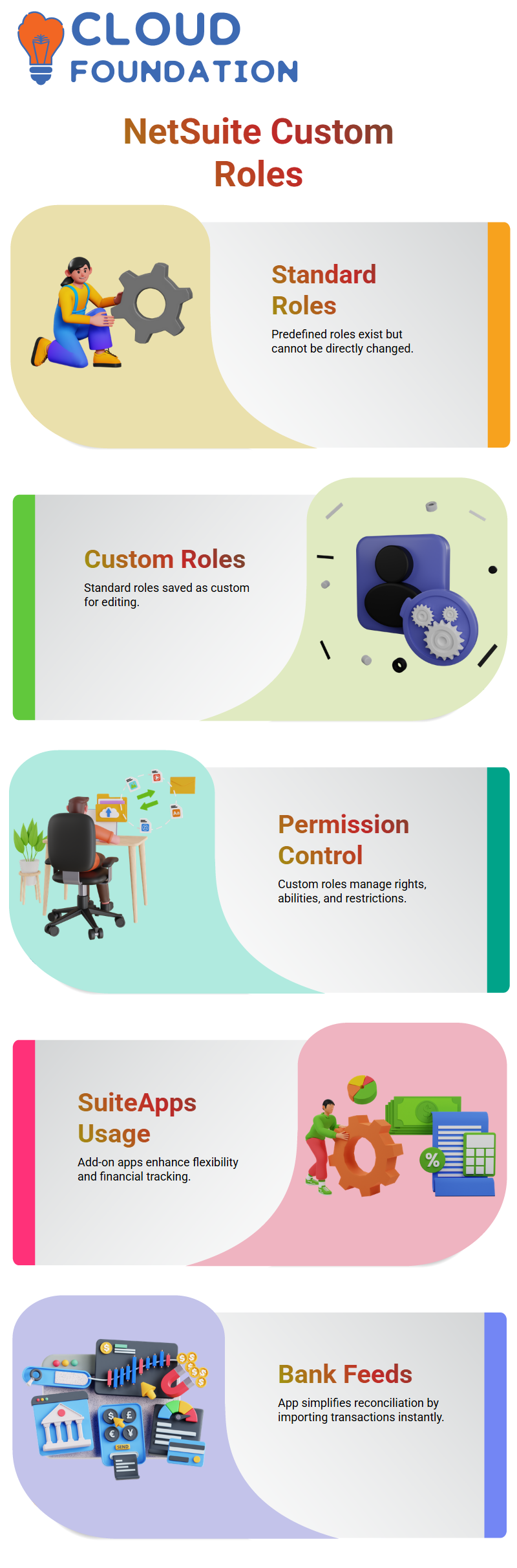
Standard jobs are already set up in NetSuite. I can’t change them directly, but I can make changes to them. You have to save a standard role as a custom role first in NetSuite when I change it.
In NetSuite, a custom job is any role that can be edited. Standard roles are those that only have one choice to change things. This small difference helps me see right away what I need to change.
It’s clear what the industry standard is for NetSuite. Most of the time, I don’t use standard jobs and only give out custom roles. In this way, permissions are always the same, entry levels are controlled, and subsidiary restrictions are applied correctly.
NetSuite already comes with roles like AP Clerk that have reasonable rights set by default. Most of the time, I don’t make roles from scratch because NetSuite saves me time by giving me ready-made models that I can tweak.

NetSuite Functional Online Training
NetSuite Roles and Processes
It’s important to make sure that users have the right abilities when setting up roles in NetSuite. You might not want to let a certain person in your company have access to certain options, like the ability to pay sales tax. That option can be easily taken away from their job, so they only have access to the features they need.
In NetSuite, it’s easy to make a custom job. For example, let’s say you work for IBM and need to make a job for the “IBM AP Clerk.” You can make that job by giving it a good name and saving it.
Once you’re there, you can make any changes you want to the job right in that custom role. In the NetSuite setup, this gives you full control over that role’s rights and abilities.
Because you will be NetSuite, you will learn about the different tasks that it can do. These steps are necessary to keep different business workflows running smoothly.
For instance, in the order-to-cash process, you’ll be in charge of everything from making the order to sending the bill. In the same way, the lead-to-code method lets you keep track of and manage leads as they turn into opportunities and then sales.
We will learn more about other NetSuite processes, like intercompany transactions, amortization schedules, and cost allocations, in our next meeting.
You can learn more about how flexible and scalable NetSuite is for different business needs by looking at these advanced features.
NetSuite has a group of add-on programs that can be put on top of the main system to make it more useful. NetSuite Expense Management Suite App is one of these kinds of apps.
This app adds advanced features that make it easier and more flexible for businesses to keep track of their spending.
NetSuite used to have a tool called “Shared Vendor Bill” that let companies share vendor bills between two different companies. But since then, newer solutions like NetSuite Net Gain have taken their place.
These solutions offer better ways to handle shared activities. Businesses can ease their financial tasks and get better at tracking expenses by these Suite Apps in NetSuite.
The Bank Feeds app is another useful Suite App that you can find in NetSuite. This app makes bank reconciliation easier by importing bank transactions into NetSuite instantly. This makes it simpler to match deposits and payments.
You can always be sure that your financial records are correct with the Bank Feeds app. This will save you time and cut down on mistakes during the accounting process.

Netsuite Functional Course Price

Nishitha
Author