Advanced level SAP CPQ Online Training
SAP CPQ in Guided Selling and Opportunity Management
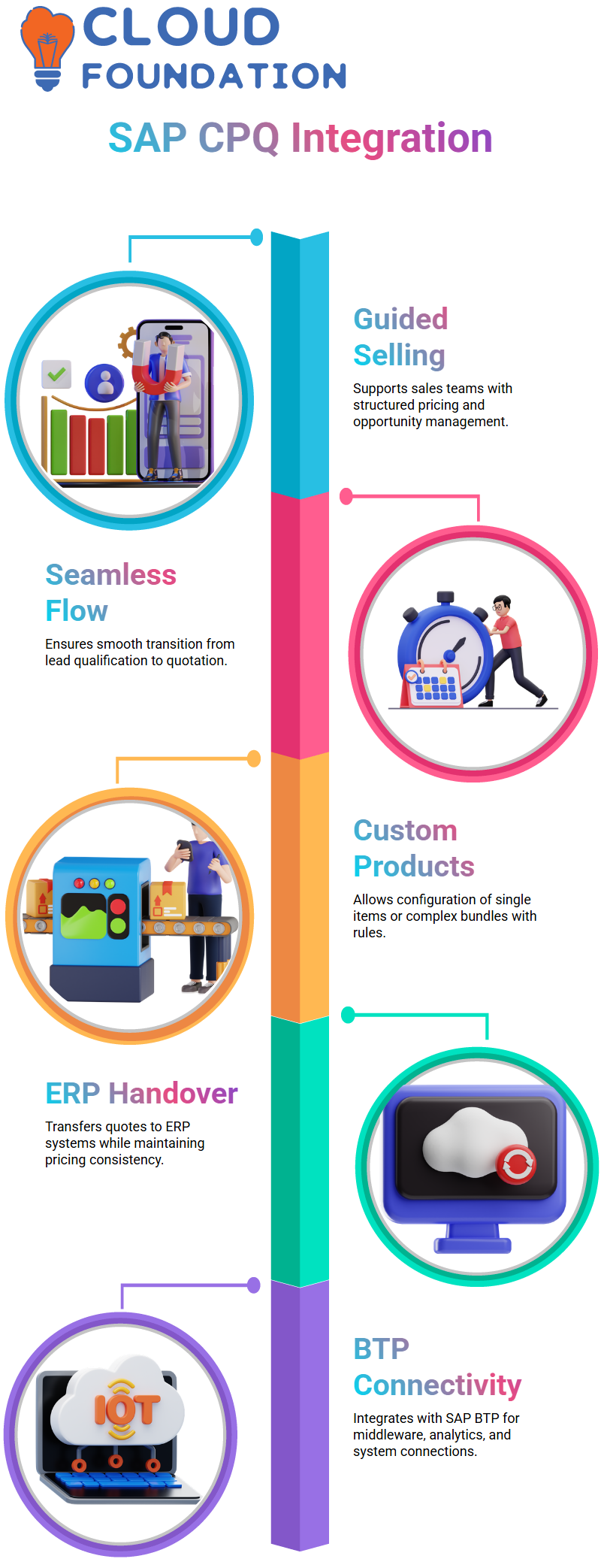
When I work with sales teams, I always start by outlining how SAP CPQ fits into the guided selling process.
At the opportunity level, the sales team negotiates the final pricing, revenue start date, revenue termination date, and billing conditions.
I envision SAP CPQ as the site where all these talks become organised and regulated, so nothing is left to guessing.
I oversee the team’s seamless transition from qualifying lead to opportunity to quotation in SAP CPQ.
Marketing gives over the lead, sales generate the opportunity, and SAP CPQ takes control when configuration, pricing, and discounting begin. Everything within SAP CPQ is clear and traceable thanks to this flow.
What I enjoy most about SAP CPQ is how it enables customizable goods.
Whether it is a single product or a complicated bundle, SAP CPQ enables me to build combinations, apply rules, and make sure the client always receives a valid and lucrative quotation with SAP CPQ.
SAP CPQ and the Quotation to ERP Integration
Once the quote is ready, I transmit it from SAP CPQ to the backend ERP system, either on-premise or in the cloud.
When the data goes into S/4HANA or ECC, SAP CPQ guarantees that pricing, margins, and settings remain constant. This handover is crucial.
For the sales side, I depend on SAP CPQ to serve as the only source of truth.
From list pricing to final negotiated price, every detail is managed in SAP CPQ before it reaches order management and invoicing.
I may access price engines, integration services, and variant settings by SAP CPQ in conjunction with SAP BTP.
This design makes SAP CPQ a central hub that speaks to CRM, ERP, and even third-party applications without disrupting the workflow.
SAP CPQ in Cloud Architecture and BTP Connectivity
I see SAP CPQ and SAP Business Technology Platform collaborating closely these days.
BTP offers the middleware, integration, and analytics layer, whereas SAP CPQ focuses on setup, pricing, and quoting.
When combined, they provide an end-to-end flow from revenue recognition to customer contact.
SAP CPQ does not operate in isolation. Through BTP, it establishes connections with C4C, S/4HANA, BRIM, and even other products like CLM and MDG.
SAP CPQ can have a central position in the sales environment thanks to this integration.
Businesses utilise BTP as the bridge and SAP CPQ as the primary quotation engine when designing their architecture.
This solution lets them expand more quickly and connect SAP CPQ with both cloud and conventional systems.
SAP CPQ in Traditional vs Cloud Implementation Paths
I regularly describe the difference between the standard runway and the cloud runway. CRM, ERP pricing, and variant configuration used to coexist in a single environment.
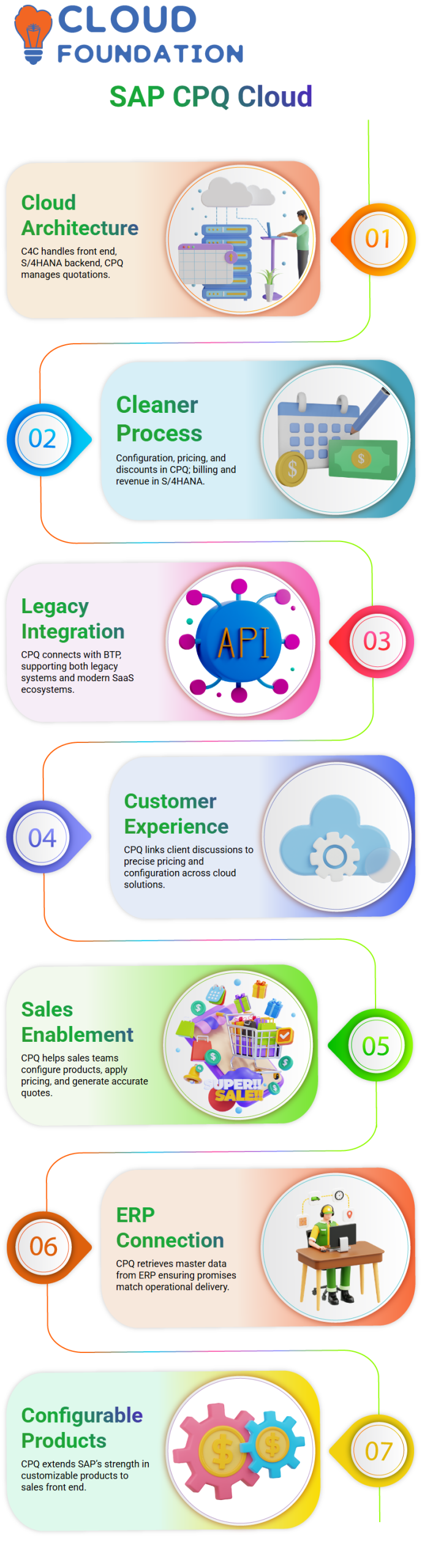
In the cloud architecture, C4C is in charge of the front end, S/4HANA is in charge of the backend, and SAP CPQ assumes the function of quotation.
With SAP CPQ on the cloud route, the procedure becomes cleaner.
Configuration, pricing, and discount logic continue in SAP CPQ, but order management, billing, and revenue operate in S/4HANA with BRIM.
SAP CPQ is a specialised and potent component because of this division of duties.
Whenever a firm wishes to combine legacy systems with the cloud, I show them how SAP CPQ can still connect BTP.
In this manner, SAP CPQ supports both old processes and contemporary SaaS ecosystems without losing control over complicated setups and pricing.
Customer Experience Landscape with SAP CPQ
When I deal with firms that want to simplify their IT stack, I usually start by talking about customer experience and where SAP CPQ fits into it.
Many firms are intending to decommission outdated CRM systems and move toward a single, automated strategy.
They want a single interconnected ecosystem that can communicate with itself, fewer apps, and less human involvement.
In my workshops, I illustrate how SAP CPQ becomes part of the wider customer experience package.
Sales Cloud, Service Cloud, Commerce Cloud, Marketing Cloud, and Customer Data Cloud are all included in this package.
SAP CPQ plays a vital role here since it immediately links client discussions to precise pricing and configuration.
When I introduce SAP CPQ to learners, I highlight that it is not only a quotation tool.
SAP CPQ operates as the core spot where salespeople design offers, configure complicated goods, and bargain successfully with clients.
From my experience, once teams understand how SAP CPQ supports customer experience end-to-end, they quickly grasp why it matters in current cloud-first architectures.

SAP CPQ Training

Sales, Commerce, and Quotation Flow Powered by SAP CPQ
I often guide Learners through the process of turning leads into opportunities and how SAP CPQ facilitates that process.
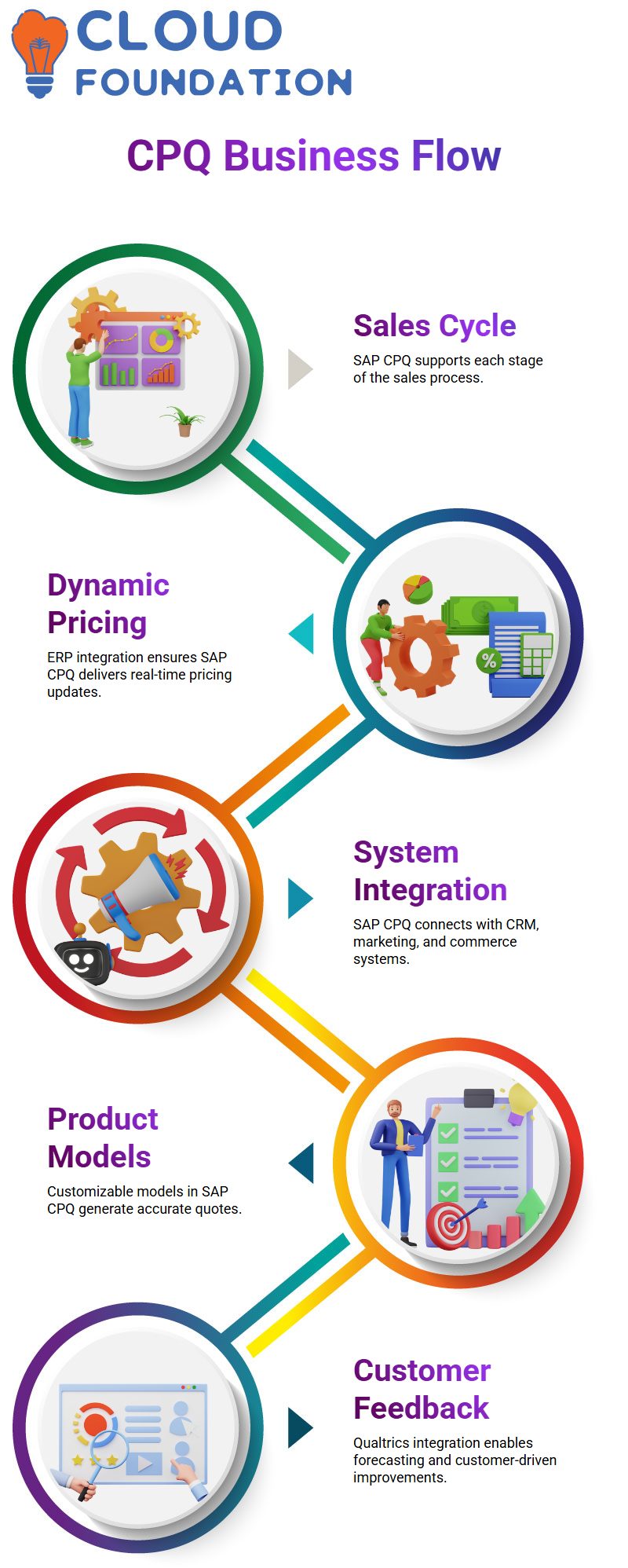
Lead generation and opportunity creation are handled by Sales Cloud, but when setup, pricing, and quoting start, SAP CPQ takes over.
With SAP CPQ, I can illustrate how sales teams set up items, apply price logic, and create correct quotes without switching platforms. This maintains a quick and steady sales cycle.
SAP CPQ guarantees that price and configuration stay the same whether the client arrives via a partner, direct sales, or online shopping.
In genuine projects I’ve seen, SAP CPQ becomes the single source of truth for quotes, which lowers mistakes and promotes confidence between sales teams and clients.
ERP Integration and Configurable Products SAP CPQ
When I describe backend connection, I always link SAP CPQ with ERP systems like S/4HANA. In most environments, ERP maintains the backbone for product master data, pricing, and customer information.
SAP CPQ retrieves necessary master data from ERP and utilises it throughout the quote process.
This method assures that what sales promises is precisely what operations can deliver.
Because SAP CPQ and SAP Variant Configuration are closely related, I take the time to discuss customizable products.
SAP has historically been strong in customizable products, and SAP CPQ extends that expertise to the sales front end.
From engineering to production to finance, SAP CPQ links configuration and pricing with actual backend capabilities.
That connection is why SAP CPQ works so well in complicated businesses.
Cloud, On-Premise, and Hybrid Architectures with SAP CPQ
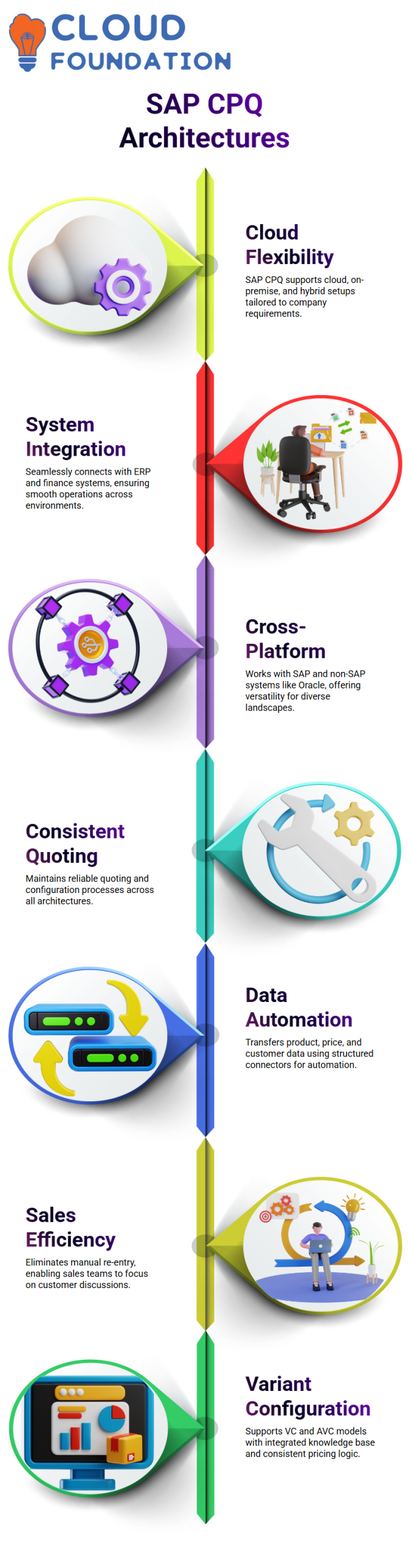
I highlight that SAP CPQ offers cloud, on-premise, and hybrid architectures based on company requirements.
While some businesses preserve essential operations on-site, others migrate everything to the cloud.
By seamlessly connecting with external finance systems or backend ERP, SAP CPQ adjusts to both situations.
I’ve seen SAP CPQ interact with non-SAP systems like Oracle in addition to SAP ERP. This versatility makes SAP CPQ attractive for enterprises with various system landscapes.
No matter the setting, SAP CPQ remains at the core of quoting and configuration, maintaining consistency across architectures.

SAP CPQ Online Training
Data Integration and Process Automation Through SAP CPQ
As we go further, I describe how integration platforms like CPI on SAP BTP are used to transfer data into SAP CPQ. This is where automation actually comes alive.
Product, price, and customer data are sent to SAP CPQ structured connectors like IDocs.
I illustrate how teams transfer just the necessary master data into SAP CPQ to maintain the system light and functional.
SAP CPQ facilitates quick, dependable quoting procedures without the need for manual re-entry once data is available.
Sales teams concentrate on discussions instead of corrections.
In my opinion as a teacher, SAP CPQ exemplifies how contemporary systems need to function: they should be automated, integrated, and focused on actual business requirements.
SAP CPQ Variant Configuration and Knowledge Base Integration
In ERP, we call it Variant Configuration (VC); in newer settings, like advanced configuration, we refer to it as AVC.
I can maintain the same business foundation while moving these configuration models forward into a cloud-ready solution, SAP CPQ.
In SAP CPQ, I establish a knowledge base much as I build a product model. I link it into a knowledge space, maintain versions for every modification, and then transfer that knowledge space straight into SAP CPQ.
This offers me comprehensive, customizable product information, including products, characteristics, and values.
The way SAP CPQ handles changing settings is what I find appealing. SAP CPQ can easily include the pricing that I provide in the backend ERP system.
This connection guarantees that the configuration and pricing logic remain consistent across platforms.
How SAP CPQ Connects with CRM and Opportunity Management
When I look at the usual business process, SAP CPQ plays a major part.
At the top layer, technologies like C4C manage leads and opportunities, and then SAP CPQ comes in via real-time interfaces.
Every stage in the sales cycle triggers interactions with SAP CPQ.
Sometimes, SAP CPQ gets information instantaneously, and other times it waits till a stage is complete.
This synchronisation guarantees that SAP CPQ only interacts when the negotiating or quote process genuinely starts.
I typically stress that pricing in SAP CPQ is dynamic. Messages move asynchronously between SAP CPQ and ERP.
SAP CPQ gets FI information, price details, and attribute data from ERP and then delivers updated quote results back.
SAP CPQ Architecture and Complex Integration Landscape
In many business installations, SAP CPQ forms part of a much wider CX infrastructure. In my opinion, SAP CPQ is connected with several apps, creating a complicated but potent environment.
For example, marketing platforms like HubSpot may create leads and transmit them into C4C, which then feeds opportunity data into SAP CPQ.
SAP CPQ integrates into contemporary customer interaction environments in this way.
Additionally, I envision SAP CPQ and SAP Commerce Cloud collaborating closely.
The sales order is automatically established in S/4HANA once Commerce Cloud creates carts and transmits data to SAP CPQ for quote processing.
SAP CPQ Implementation Approach and Product Modelling Stages
When businesses deploy SAP CPQ, they follow organised steps.
I normally divide it down into identifying products, developing price worksheets, constructing product models, testing configurations, and then putting them into production.
Product modelling in SAP CPQ is all about customizable products.
I establish properties, values, and dependencies so SAP CPQ may create correct quotes every time.
What I see is that most firms don’t want to replace their old apps.
Instead, they connect them with SAP CPQ, which makes SAP CPQ a fundamental centre in the architecture.
SAP CPQ with Qualtrics and Feedback-Driven Commerce
SAP CPQ combined with Qualtrics is one of the most intriguing use cases I’ve encountered.
In this system, consumers request quotations from SAP CPQ, add discounts, approve purchases, and then Qualtrics delivers surveys for feedback.
Qualtrics analyses client replies and provides alerts back into SAP CPQ and C4C.
This enables SAP CPQ to provide demand forecasting and product development in addition to transaction management.
With SAP CPQ, feedback loops become part of the whole quote-to-cash process, making the system much more customer-focused.
ERP and SAP CPQ Terminology Alignment
I constantly explain the distinctions in terminology when I teach folks on SAP CPQ. In ERP, we speak about materials, while in SAP CPQ, we call them products.
Customers are referred to in ERP, while accounts are used in SAP CPQ and CX systems.
ERP features translate into SAP CPQ characteristics, and object dependencies move from the knowledge space into SAP CPQ.
Once all this information is accessible, I can make quotes in SAP CPQ, transmit them into ERP for sales orders, or even route them into BRIM when working with subscription-based SaaS solutions.
Contract Foundations with SAP CPQ
I work closely with contract lifecycle tools where I design contracts, establish terms, and handle discussions.
I personally oversee document creation and clause control so that, when the time comes, SAP CPQ gets clean and authorised data.
This technique helps learners understand why SAP CPQ performs best when the contract base is sound.
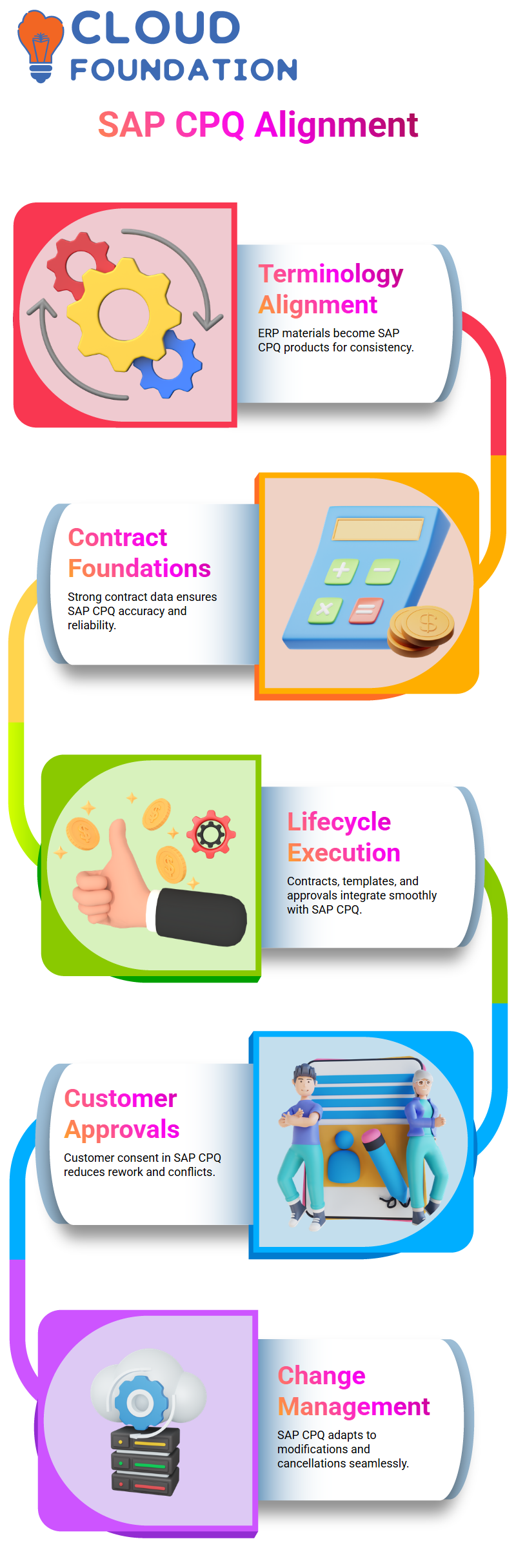
I describe each stage in simple words since SAP CPQ relies largely on precise contract data.
SAP CPQ becomes more than just a quote tool when I correctly align contract terms; it becomes a component of a whole business process.
Contract Lifecycle Execution Aligned with SAP CPQ
I lead Learners through the whole contract lifecycle and show how it ties to SAP CPQ in practical cases.
I write contracts, handle line items, construct templates, and apply approvals before anything reaches SAP CPQ.
Instead of working in isolation, this practical flow enables Learners to see how SAP CPQ integrates smoothly following contract validation.
Pricing and configuration are ultimately impacted by each renewal, modification, or change, which is why SAP CPQ is essential.
I constantly illustrate how clean lifecycle management enhances SAP CPQ accuracy and customer confidence.
Customer Approvals and Workflow Integration with SAP CPQ
I usually highlight customer approval procedures since they directly affect SAP CPQ results. Contracts are sent to customers for inspection and negotiation after corporate approval.
The customer’s consent is entered into SAP CPQ, guaranteeing that bids accurately represent the conditions agreed upon.
This is how I describe the real-world connection between legal procedures and SAP CPQ.
By connecting approval procedures with SAP CPQ, I assist Learners learn how to minimise rework and price conflicts.
Change and Cancellation Management SAP CPQ
One of my favourite subjects is change management, as it demonstrates SAP CPQ’s adaptability.
I show how I alter conditions, terminate agreements, and change contracts while maintaining SAP CPQ synchronisation.
Each modification is reflected promptly in SAP CPQ, which helps maintain consistency across sales and legal teams.
I also go into great depth about cancellations and demonstrate how SAP CPQ manages them without interfering with the workflow.
By handling modifications appropriately, I guarantee SAP CPQ always replicates the current contract condition.

SAP CPQ Course Price

Vanitha
Author